
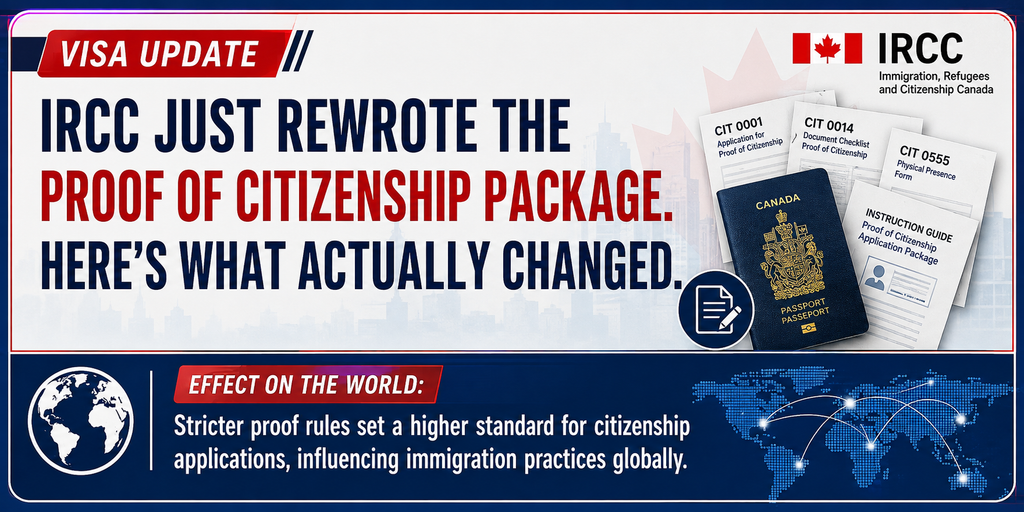
IRCC proof of citizenship update, on August 25, Immigration, Refugees and Citizenship Canada modified four crucial documents for the proof of citizenship process, namely the application form (CIT 0001), document checklist (CIT 0014), physical presence form(CITS) (M–055)1, and instruction guide that connected them. The criteria for citizenship did not change at all. The change is in the amount of evidence IRCC now demands and the level of detail required in its presentation.
Why This Upgrade Exists?
Canadians who were born outside of Canada can pass citizenship to a child born overseas since Bill C-3 took effect, but only if they can prove 1,095 cumulative days of physical presence in Canada before that child’s birth. The guideline only applies to children born on or after December 15, 2025. Anyone born before is included by the repeal of the first-generation restriction in Bill C-3 and never has to show a single day of presence.
Since the youngest candidate touched by this guideline is still under a year old, the number of families facing it is still rather limited. It will not remain thus. Every month brings more children born under the new law, which is probably why IRCC acted now to raise its evidence requirements instead of waiting.
What is Different on the Forms?
The improvements come in two categories: those that increase the bar and those that add clarity.
Regarding clarity, if applicants respond affirmatively to the physical presence question in Section 13, CIT 0001 now specifies by name the form they should fill out; formerly, it only pointed them toward the instruction manual. Additionally more specific than previously are the evidence categories on CIT 0014, encompassing employment and education records, travel documents, residential records, Canadian government records, and two categories of sworn affidavits.
On the more rigorous side, three modifications stand out:
- Government documents today refer to Canadian government records. The outdated list took other government documents without identifying a nation. That uncertainty has vanished.
- Simple letters no longer count. A note from a church, union, or local group used to be okay on its own. It must now be a sworn affidavit signed in front of a notary public or commissioner of oaths, including the signer’s postal address and phone number or email. Swearing these affidavits on a relative’s behalf is forbidden to family members, including in-laws and first cousins.
- CIT 0555 initially requests verification contacts. The updated form features a line indicating that all submitted information is subject to IRCC verification, and another line requesting applicants to provide contact details for individuals who can verify the parent’s time in Canada, even before an officer opens the file.

Interestingly, the instruction manual excluded two long-standing definitions: that in Canada a calendar day counts as a full day regardless of how much of it was spent there, and that cumulative implies the days need not be consecutive. Neither sentence turned back in other parts of the package. Still, the worked example on CIT 0555 counts an eight-day journey from admission to departure inclusive, so the underlying arithmetic has not altered despite the plain-language explanation vanishing.
If You Have Not Yet Applied
IRCC sends back unfinished applications, thereby resetting your position in the queue, rather than rejecting them immediately. You can proactively submit updates via IRCC’s web form using your Unique Client Identifier and application number if you’re partway through processing and believe your documents might not meet the new criteria. Section 16 of CIT 0001 requires candidates to inform IRCC of any change in their data while the case is still open.
A few sensible actions to take right now: Maintain current contact information so you don’t miss a request for documentation, get ahead of any affidavits you’ll need by ensuring your witnesses will provide their contact information and properly swear the statement, and if a record just does not exist, obtain written confirmation of this from the appropriate institution rather than leaving the gap unexplained.
For families unable to reach the 1,095-day mark
A child born overseas has more than one path to citizenship apart from the physical presence need. If the child was born in Canada, or if at the time the Canadian parent was working overseas with the Canadian Armed Forces or national public service, it is irrelevant. Families who don’t fit either exception can still apply for a permanent residence visa, then a citizenship grant, which includes a special clause for children who would otherwise be left stateless.
The fundamental issue is that Bill C-3’s eligibility requirements have not changed. Moved is the paperwork criteria supporting them; for anyone now putting a file together, that difference is noteworthy before submission instead of after a return letter shows up.