
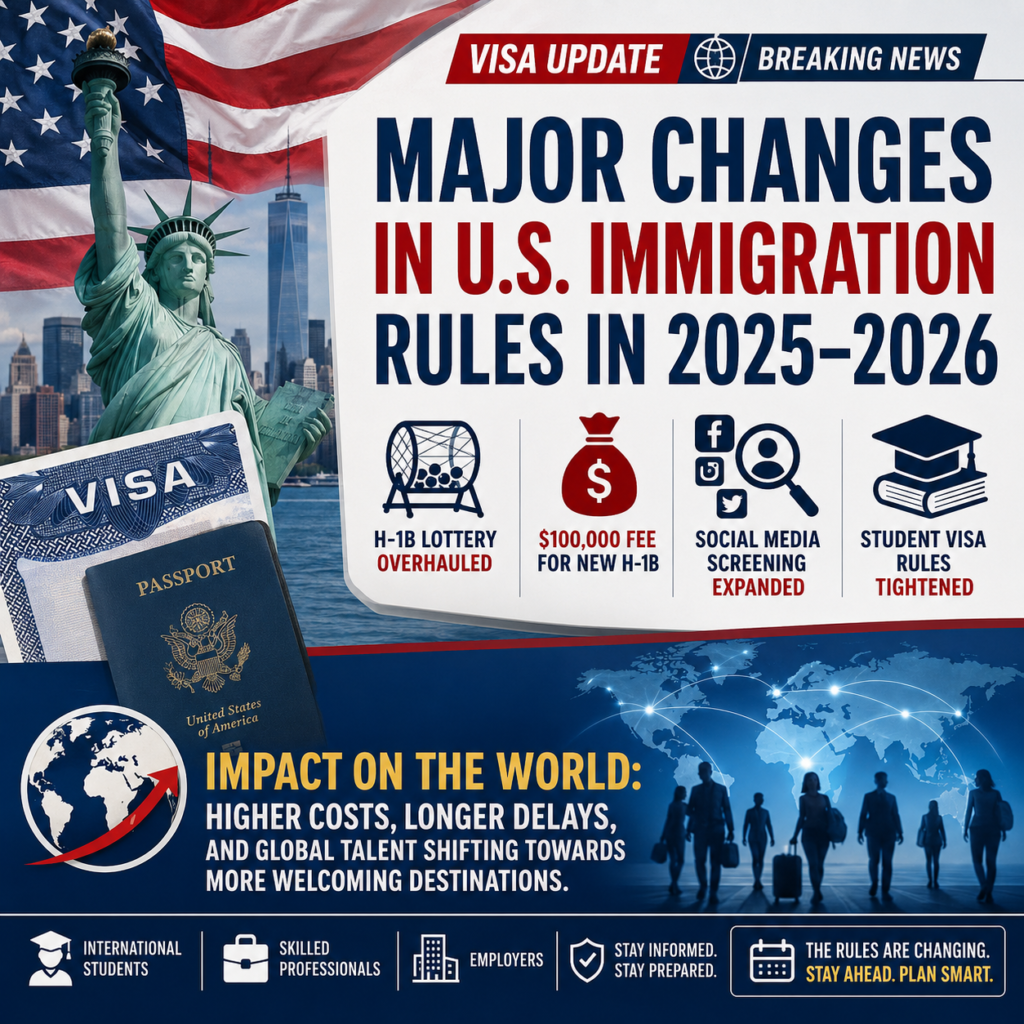
Significant alterations are occurring in the US Immigration Framework. For international learners, skilled workers, and their hiring businesses, regulations are shifting rapidly.
The Trump administration has implemented numerous modifications to the H-1B visa scheme and student visa policies for 2025 and 2026. Adjustments range from the methods of H-1B visa allocations to alterations in the duration international students can remain, representing some of the largest changes to the US immigration system in decades.
Essential informations need to know
H-1B Visa: No More Random Lottery
A new regulation was exposed by the relevant authority on December 23, 2025, which will substitute the previously announced one. The selection process will now emphasize wages. The former H-1B lottery was based on chance. By the fiscal year of 2027, on February 27, 2026, this new regulation introduced the H-1B cap registration season. Those with higher salary proposals will enjoy enhanced chances of selection:
- Level IV (highest wage): 4 chances
- Level III: 3 chances
- Level II: 2 chances
- Level I (lowest wage): 1 chance
The annual cap on H-1B visas remains at 85,000,out of which division is, 65,000 for the standard category and 20,000 for holders of advanced degrees from US institutions. The selection protocol has undergone considerable modifications. In fiscal year 2025, nearly 90% of H-1B applications came from students. Many of these applicants fell into Level I or Level II due to their limited work experience. As a result, those entry-level applicants have significantly decreased chances of selection.
According to a spokesperson from USCIS: “The former random selection process for H-1B applications was utilized unfairly, allowing US companies to recruit employees at lower wages than what they would offer to American workers.” He continued by stating that the new regulation aims to “enhance the H-1B program and boost America’s competitiveness.”
A Large Fee for New H-1B Applicants
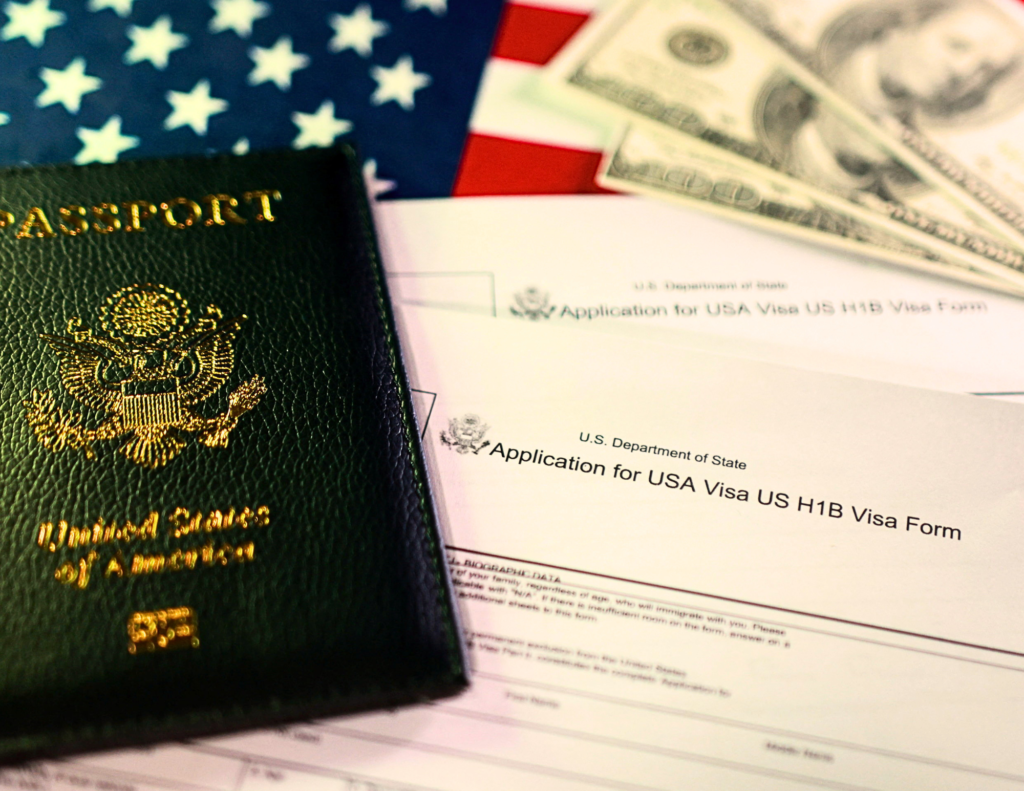
The administration has also established a financial hurdle. Individuals seeking to apply for an H-1B visa now need to pay an added fee of $100,000. This requirement affects those outside the US without a valid H-1B visa, as previously announced by the President on September 19, 2025.
This fee has faced legal challenges. On June 8, 2026, a US District Court ruled it invalid. The federal government appealed on June 11, leaving the issue unresolved at this time. Employers and applicants should exercise caution and obtain legal counsel prior to submission.
Your Social Media Accounts Are Under Scrutiny
Beginning December 15, 2025, the US State Department began closely monitoring and reviewing social media profiles of all applicants and their H-4 dependents. Previously, this scrutiny was limited to students and exchange visitors.
Applicants are required to adjust their social media accounts to be public for verification purposes. Consular officials will examine profiles, publicly accessible posts, and details on social networks. If applicants maintain private accounts or lack an online presence, it could negatively affect their applications.
Additionally, consular officials must review the LinkedIn profiles or CVs of H-1B and H-4 candidates to verify their work experience in fields related to misinformation, disinformation, compliance, online safety, and fact-checking. Applicants who have attempted to suppress or limit protected speech within the US may be deemed ineligible.
Due to this, there have been modifications: Several consular interviews that were initially planned for December 15, 2025 or later have now delayed by several months, with some taking place as late as September 2026.
Student Visas: No Duration of Status
The updates are also substantial for foreign students. A proposal from the Department of Homeland Security aims to abolish the Duration of Status framework that has been in place for close to half a century.
Currently, F-1 students and J-1 exchange visitors can reside in the US without a specified exit date as long as they are enrolled and maintain their status. The new proposed regulation would replace this with set admission periods.
Most students would be permitted to remain for a maximum of four years or the duration of their academic program, whichever is shorter. Those in longer programs, including doctoral students and certain dual-degree programs, will need to submit extension requests to USCIS.
There are also several limitations:
- First-year F-1 undergraduate students are prohibited from changing their major or transferring to a different college.
- Graduate students are not allowed to change their program after they have started.
- Graduates may not pursue another major at a similar or lesser educational level.
- The grace period following program completion has been reduced from 60 days to 30 days.
An immigration attorney commented that this new regulation is “unnecessary and overly restrictive” and that the limitations placed on students concerning changes in majors or universities “lack rationale.” Another specialist concurred, stating the updated rules “introduce extra bureaucracy and obstacles” for F-1 students.
Higher Wages for H-1B Workers
Increased compensation for H-1B Employees. The Department of Labor plans to increase the minimum salaries by 21% to 33%, along with experience levels based on job requirements, for H-1B workers and individuals with employment-based green cards.
This initiative was announced in March 2026, with expectations that the finalized version will be released in either early or late 2026.
For companies, especially smaller ones, this wage increase will influence the decision on whether it is viable to sponsor foreign employees, particularly for new hires.
What’s Next
Further developments are anticipated. The government is continuously working on a new regulation which could either limit or end Optional Practical Training (OPT), which is a one-year work permit enabling graduates to acquire experience in their field. This stands as an exception.
The End H-1B Visa Abuse Act of 2026 is a proposal that would mandate companies to compensate foreign employees at least twice the median wage and lower the annual limit for H-2 visas to 50,000. A rule that would limit the criteria for H-1B specialized positions and third-party placements has been proposed.
What This Means for You
The requirements are obviously getting more strict, which will affect skilled workers, international students, and companies that depend on talent from round the globe.
- Plan ahead. The designated admission periods imply that students cannot rely on an extended stay that aligns with their studies. Extensions necessitate paperwork.
- Review your social media. Today, social media evaluations are part of almost all visa categories. Your online activities are quite impactful.
- Prepare for costs. The financial burden of sponsoring employees is increasing due to the $100,000 fee, higher wages, and additional filing responsibilities.
- Explore options. One expert suggested that countries such as Canada, the UK, and Australia are positioning themselves as reliable alternatives.
The U.S. immigration landscape is changing gradually.