
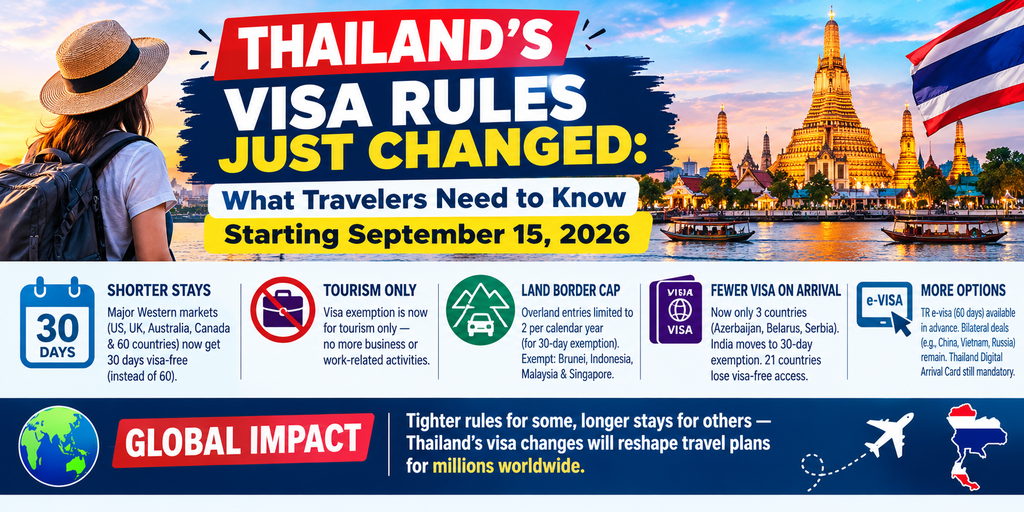
Thailand 60-day visa exemption ends Sept 15, 2026. Most travelers now get 30 days for tourism only, land border runs are capped, and 21 countries need visas.
It’s time to change your schedule if the kind 60-day visa waiver available since mid-2024 has been influencing your trip to Thailand plans. The program, Thailand 60-day visa exemption ends as of September 15, 2026, replaced by a more complex system that limits who qualifies for what, shortens most stays, and narrows the use for which visa-free admission is permissible.
Travelers from 93 nations and territories benefited from one of the area’s more laid-back admission rules for two years, 60 days, no visa needed, and adequate flexibility to cover some minor business or professional activity as well as tourism. Four more orders announced in Thailand’s Royal Gazette on August 31, 2026 mark the end of that period. Here is what really does change.
Half the time for large Western markets
Still not subject to a visa for a regular trip, tourists from the United States, United Kingdom, Australia, and Canada won’t need one; however, the clock now runs out at 30 days rather than 60. That is the main adjustment affecting a total of 60 nations and regions including most of the EU, New Zealand, South Africa, various Gulf states, and Pacific rim countries like Japan, South Korea, Singapore, and Malaysia.
Though it has to be set in person with Thai immigration once you are already in the nation and approval is not automatic, an extension of up to 30 more days is still projected to be available. Anyone looking for a guaranteed 60-day stay from the beginning now has another choice: submitting a “TR” category e-visa application in advance. This tourist visa gives 60 days per entry, is valid for three months for a single entry, and may be extended locally by another 30 days.
No More Gray Area for Business Travel Only
Maybe the more important change is in scale instead of time. The 60-day exemption under the previous guidelines was a practical choice for visitors, those passing by for a few days for business or professional activities, or consultants because it included travel as well as some short-term business or professional activity. The new arrangement is clear: it is for travel, period. Early in September, Thailand’s Ministry of Foreign Affairs confirmed this clearly by saying that anyone entering for a different reason needs the visa type that really matches their activity. People who have depended on the previous exemption for work-related travels will have to rethink their documentation.
Crossings at the Land Border Now Restricted
Under the new 30-day exemption, overland visitors get another wrinkle: land-border entries are limited at two every calendar year. This mostly impacts those who “border run,” which is when long-term tourists and digital nomads leave and then re-enter Thailand overland to reset their visa-free clock, therefore circumventing a typical problem. If you are flying or sea, the cap does not apply; Brunei, Indonesia, Malaysia, and Singapore citizens are free from it all.
Winners, Losers, and a Shrinking Visa-on-Arrival List
Not every nation falls into the 30-day range. Mauritius and Seychelles are each covered by a separate 15-day tourist exemption. This change means a cut, for Mauritian visitors, who used to have 60 days to stay. The island of Seychelles was not included in the plan at all.
Visa on Arrival used to be offered in 31 countries. Today Visa on Arrival is only available in three countries: Azerbaijan, Belarus and Serbia. For a stay of 15 days Visa on Arrival costs 2,000 baht, the fee, as before. Once in the Visa on Arrival group, India is actually rising into the more desirable 30-day exemption class, one of the rare upgrades in this reform.
The biggest change affects 21 countries that now travel without a visa but will lose that right totally. People from Mexico, Colombia, Morocco, Sri Lanka, Uruguay, and Panama will now have to get a visa before they leave. The good news is that Thailand has launched e-visa processing throughout its whole diplomatic network, therefore most of these passengers should find it quite simple to apply online before to a trip.
Bilateral Agreement Is a Different Story
Losing a position on the general exemption list does not inevitably equate to losing visa-free entry completely; this is worth noting. Countries that have their own bilateral agreements, such as China, Vietnam, Russia, Laos, Mongolia, Hong Kong, Macao, and Timor-Leste, will continue to offer 30-day stays. Under their own agreements, Argentina, Brazil, Chile, Peru, and South Korea have 90-day access, while Cambodia has a 14-day arrangement. Myanmar citizens entering by air still receive 14 days. Thailand seems to be going toward combining all of this under a “one country, one regime” attitude, but for now, these bilateral agreements operate apart from the new general plan.
A Grace Period for Those Already in Transit
None of this impacts you if your flight arrives on or before September 14. Thailand’s government has confirmed that whatever stay length you’re granted at immigration on entry stays locked in, even after the new rules kick in the following day. A tourist coming under the previous plan on September 14 still has sixty days stamped.
One thing that has not changed
Whatever visa type fits you, the Thailand Digital Arrival Card is still required. Every foreign visitor, regardless of whether they enter visa-free, on an e-visa, or under any other circumstances, still has to fill it out electronically before arriving.
The Bottom Line
Thailand is not closing its doors to tourists. The 30‑day exemption still works for 60 nations. Options such as the TR e‑visa make longer stays easier. The margin for error is smaller. The reason for entry counts more than before. Tourists, from 21 nations face a visa application they did not face before. If you plan to travel to Thailand in the few months it is a good idea to check exactly what kind of passport you have before you book your trip.