South Africa Action to Charge Travelers About $30 for Its New Electronic Travel Authorizations
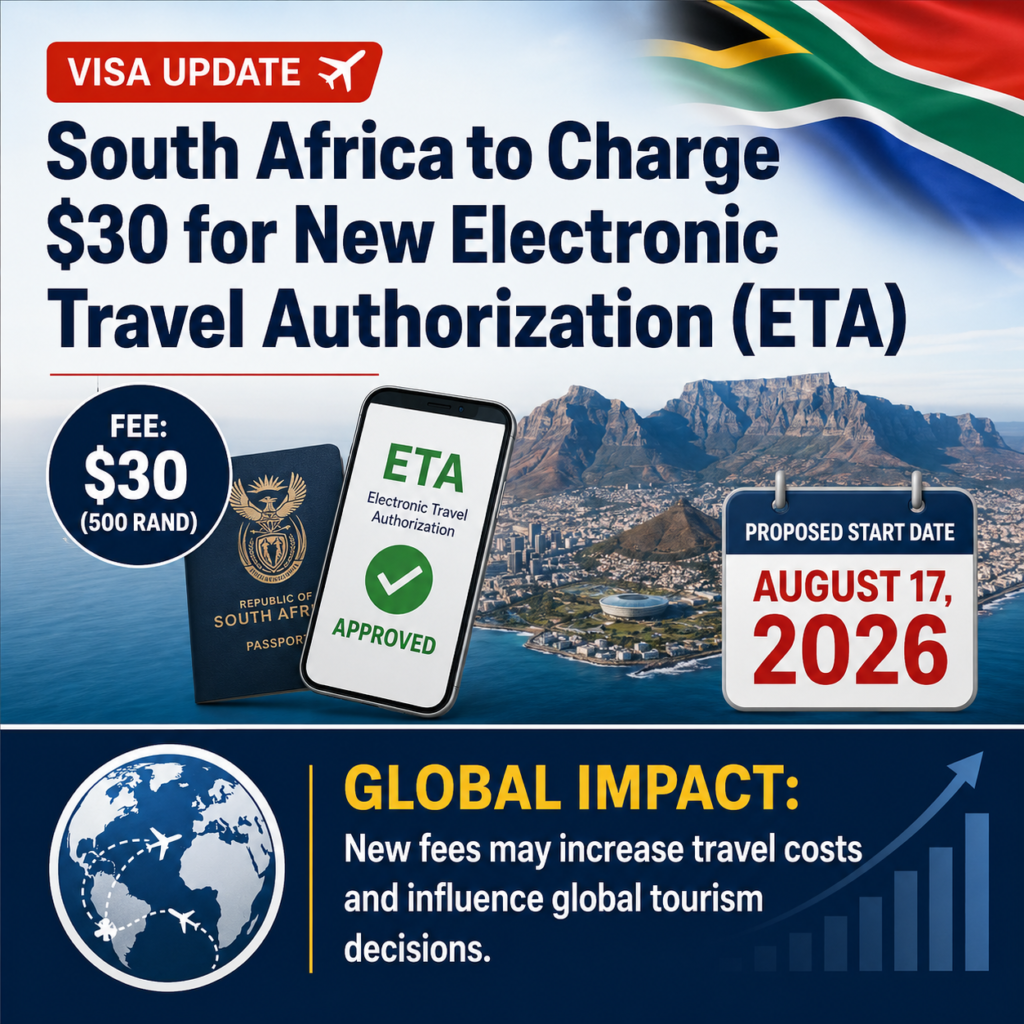
The immigration agency of South Africa has made way for a new fee for foreign visitors wishing to enter the nation via its still-developing electronic travel authorization (ETA) system. Along with other visa and permit applications submitted online, the Department of Home Affairs has released draft regulations introducing a 500-rand charge, approximately $30, for handling ETA applications. Although the rule still has to withstand a public comment period before becoming final, if the proposal proceeds as written, it would become effective on August 17, 2026.
Reasons for the Fee’s Introduction
The introduction of South Africa’s ETA system in October 2025 was deliberately planned to coincide with the G20 conference the nation was hosting. Since it lacked an integrated online payment collection capability, the system at the time ran without any specialized processing burden.
According to Home Affairs, that configuration was never intended to be fixed. Officials now contend that in the long term it is not practical to pay for the platform totally out of the state coffers. The agency wants to begin billing applicants directly for the service with an online payment feature ready to be implemented.
It’s important to remember that the suggested 500-rand fee goes beyond the ETA. The proposed law would impose the same processing charge on every visa or permission application submitted and handled digitally, therefore possibly piling on top of any visa charge now applicable to a particular visitor.
What Different Travelers Would Actually Pay
The new system’s whole expense would mostly rely on a visitor’s visa status and nationality.
A person requiring a visa and paying the customary visa cost would face a total of 925 rand, which comprises the 500-rand processing charge and the current 425-rand fee for a visitor’s visa.
Travelers requiring a visa but excused from the visa charge itself would just pay the 500-rand processing cost associated with the ETA.
Home Affairs has framed this as an improvement over the current outsourced application procedure, in which some applicants apparently pay around 1,550 rand in service fees to the third-party firm handling submissions, on top of the 425-rand visa fee, for a total of 1,975 rand. That comparison suggests that using the ETA platform to route an application would more than halve the expense.

Non-Visa Tourists Not Being Required to Utilize
One feature that will probably be most important to visitors from the United States and Europe is that the ETA will not be required for countries that already have visa-free entry to South Africa, at least not in this first phase.
For stays of up to 90 days, people from visa-exempt nations may continue to enter South Africa the way they always have—with no fee and no new forms. Rather, for these tourists, the agency is presenting the ETA as an optional add-on that might hasten border processing. Those who choose to participate voluntarily would still have to pay the 500-rand charge, but nothing about their current visa-free status would alter.
A Fairly Limited Rollout
Even if the ETA has garnered a lot of buzz, its reach is still small for the time being. Applications are currently only accepted on the site, found at eta.dha.gov.za, from adult ordinary passport holders from four nations: China, India, Indonesia, and Mexico.
There is also a geographic limit. Travelers utilizing the ETA have to arrive at either OR Tambo International Airport in Johannesburg, Cape Town International Airport, or Lanseria International Airport. Anyone crossing at a different border station is still subject to the earlier processes.
When South Africa initially introduced the system in September 2025, officials characterized these four nationalities as simply the starting group with intentions to eventually expand the ETA to encompass all nations whose people require a visa to enter South Africa. But the government has not yet released a timetable for when and which countries would follow.
What Occurs Next?
Nothing is set in stone as the charge is only now in draft form. Based on that input, Home Affairs might change the regulations, including the cost or the effective date, before finalizing anything; the public has till August 11 to submit comments on the proposal.
For now, the main conclusions are clear: there is a $30-ish charge planned for ETA and other online visa applications; visa-exempt passengers won’t be obliged to pay it unless they choose to use the ETA voluntarily; and the expansion to additional nationalities is still under development. Anyone considering a trip to South Africa in the next few months would do well to look for updates as the proposed August 17 start date gets closer, since the last version of these rules has not yet been made public
For More Information contact your regional / country South African Embassy