
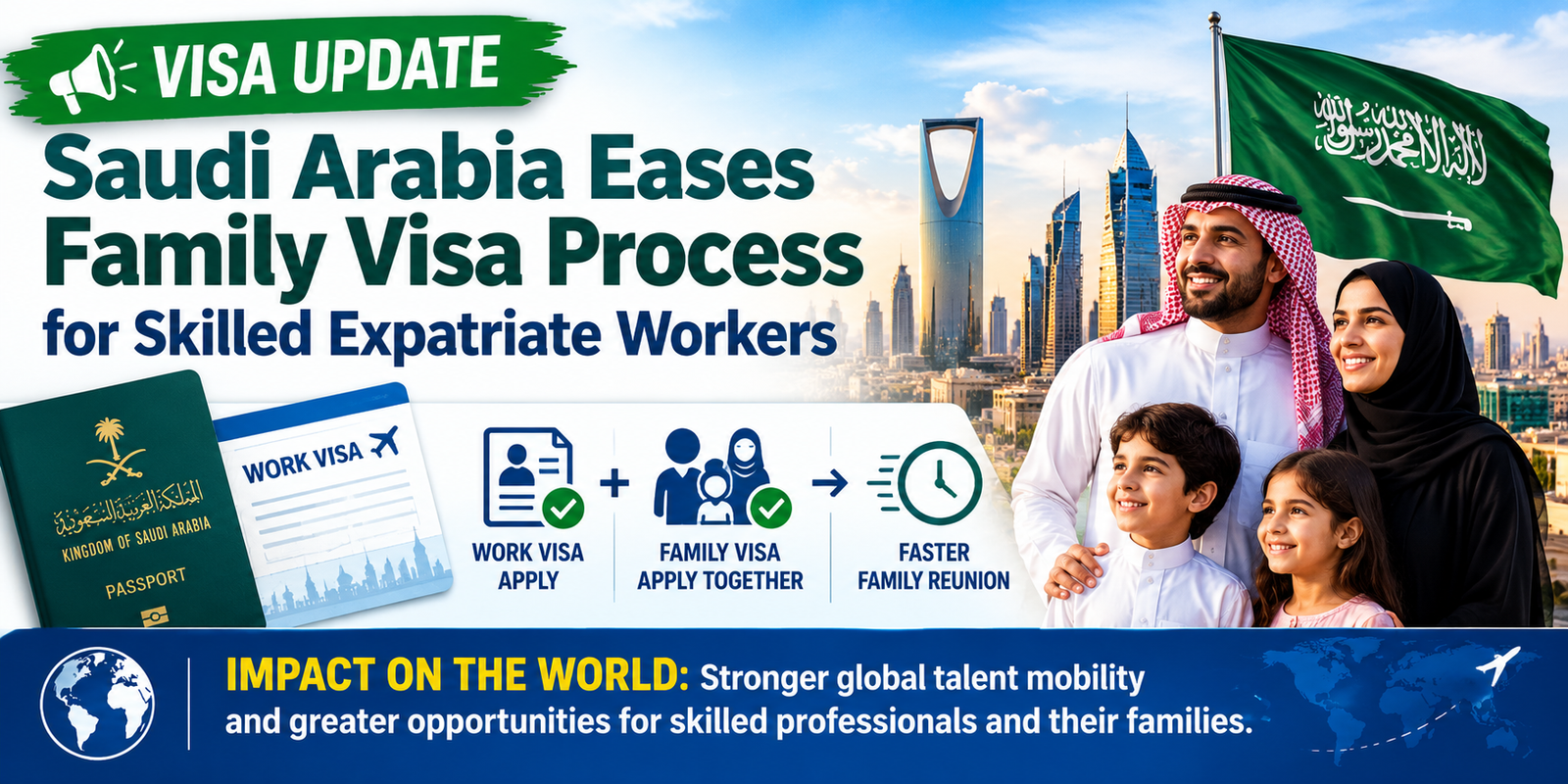
Saudi Arabia eases family visa process and has introduced a significant revision to its immigration system, one that should make moving significantly easier for skilled international workers. Under the amended regulation, qualified expat employees may now apply for entry visas for qualifying family members concurrently with processing their own work visa, therefore removing the need to wait until their employment papers are completely completed.
What the Ministry of Interior Said
Saudi Arabia’s Ministry of Interior made the announcement, confirming that qualified expatriate heads of households can now ask for entry visas for qualified dependents at the same time they apply for their work visa. In the past, the usual order involved a foreign worker finishing the whole employment visa procedure first, and only then starting the independent process of bringing family members into the country. That two-step method usually meant months of separation between a worker’s arrival and their family’s capacity to join them.
The Kingdom is effectively shortening a timescale many expatriate professionals have long considered one of the more irritating aspects of moving for work by letting both processes run concurrently. This change means an improvement in the way families live. These families used to deal with visa systems, in other parts of the Gulf.
Who is eligible under the new law?
The policy is crystal clear about which members of the family are covered. The ministry states that eligible dependents comprise:
- Spouses
- Sons below 25 years old
- Unwed daughter
This scope reflects the dependent categories often acknowledged under Saudi residency law, but the essential modification is when their visa procedure may start, not who qualifies. Eligible family members no longer have to wait in a holding pattern while the principal applicant’s work visa works its way through approval.
It’s important to keep in mind that a full residency is different from an entry visa. Family members will still have to do through regular residency processes once in the Kingdom in accordance with current laws. The new legislation modifies the sequencing and timing of the process rather than the fundamental legal criteria for founding residence in Saudi Arabia.
A Harmonized Policy Change
This wasn’t a choice arrived at in isolation. The Ministry of Interior created the adjustment in cooperation with both the Ministry of Foreign Affairs and the Ministry of Human Resources and Social Development, hence hinting at a broader, cross-agency drive rather than a small administrative change. The government’s announcement presented it as part of an ongoing effort to raise the quality of life for Kingdom inhabitants, phrasing that has been a repeating theme in Saudi Arabia’s social and economic reform agenda throughout the past several years.

This also fits into a more general trend. As Saudi Arabia competes for qualified foreign labor, it has been actively amending its immigration and labor legislation. For example, in early 2026, authorities imposed fresh restrictions on how many work visas companies might acquire for foreign employees, as part of a larger realignment of the Kingdom’s management of its expat workforce. Seen together with that constraint on the employer side, this family visa modification points to a more focused strategy: increasing entry restrictions in certain areas while improving the experience for the particular profile of workers Saudi Arabia most wants to keep: highly skilled professionals.
Why This Matters for Expat Families
This is a clear selling feature for businesses hiring foreign talent into Saudi Arabia. Rarely does an individual make relocation choices alone; they include spouses, kids, and entire homes evaluating whether a foreign move is physically viable. One of the most often occurring areas of dispute in that decision-making process is removed by a quicker, more synchronized visa route.
For families personally, the practical advantage is clear: less time spent apart. Under the previous arrangement, a worker might wait for their own documentation to clear first before even beginning the process for their partner or children, so spending their first few months in the Kingdom alone. Running both tracks simultaneously significantly closes that gap even if final residency processes still occur after arrival.
Going Forward: What to Expect
Like most announcements of this scope, the realistic specifics, processing times, needed paperwork, and how tightly the skilled worker classification will be applied, are expected to grow more obvious as execution goes along. Because execution details can change following an initial announcement, possible candidates and their companies would be advised to check specifics with official Saudi channels or immigration specialists rather than depending just on general reporting.
The course of travel is still evident. With an eye toward drawing and keeping skilled foreign professionals, Saudi Arabia keeps modifying its visa and labor rules, therefore this most recent change eradicates a long-standing cause of delay for expatriate families seeking to live together in the Kingdom.