
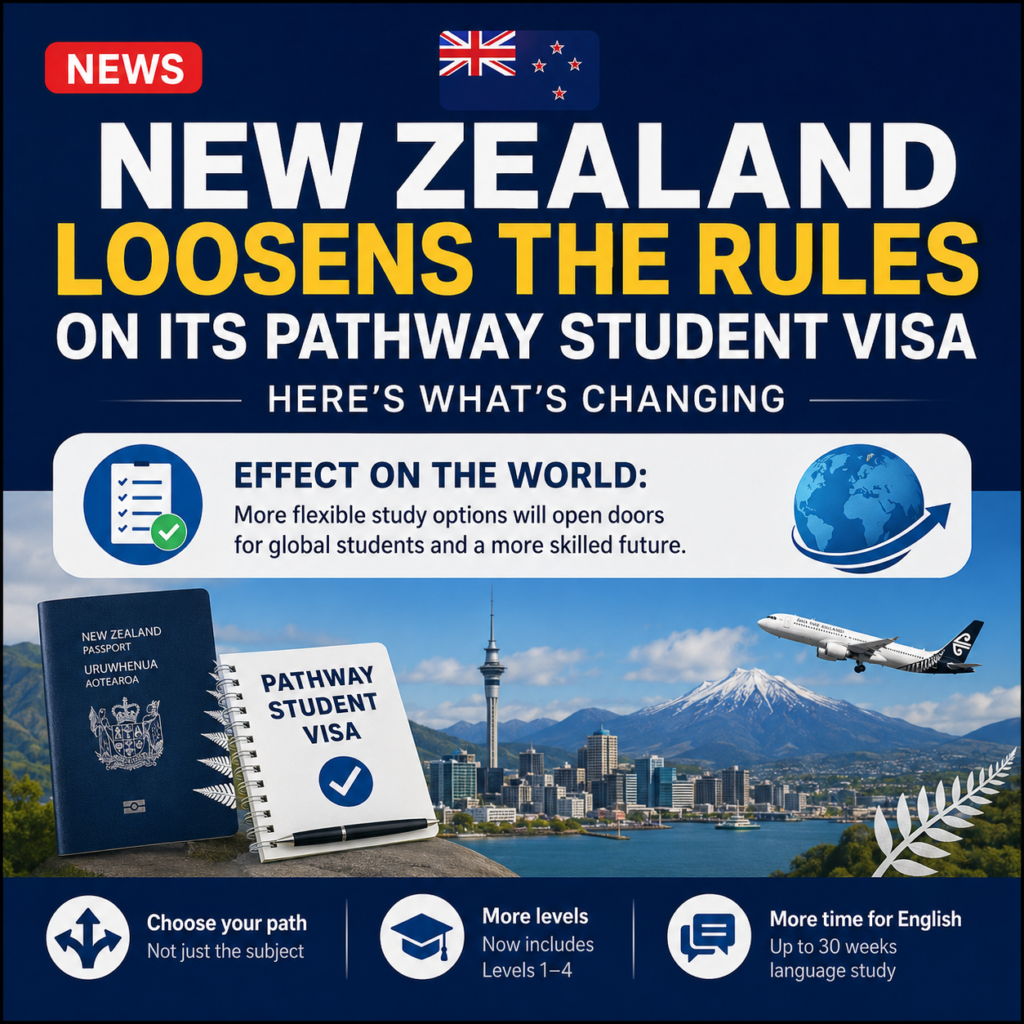
Here’s What’s Changing
You know how impossible it might seem if you have ever tried to organize five years of your life forward. Still, that is mostly New Zealand‘s Pathway Student Visa’s past demand of young candidates: promise a particular postsecondary degree before you had even completed high school. From 20 July, that requirement is being relaxed, along with two other adjustments that together make the visa noticeably more forgiving for the way students’ plans actually evolve.
Immigration New Zealand confirmed the changes as part of its broader International Education Going for Growth strategy, and industry groups representing schools, English-language providers, and tertiary institutions have responded positively. The reaction isn’t surprising, the update addresses a genuine friction point in the system, one that has quietly pushed some students toward less flexible or more expensive alternatives simply because they weren’t ready to lock in a discipline at 17.
Room to Change Your Mind
The Pathway Student Visa was designed to let a student move through up to three linked courses, which are, secondary school, then a foundation programme, then a degree, on a single visa valid for up to five years, rather than filing a fresh application at every stage. It’s a sensible idea in principle. The catch was that Year 12 and 13 students had to nominate their intended tertiary discipline upfront, and that discipline was written into their visa conditions.
From 20 July, that’s no longer the case. Secondary students transitioning into tertiary study will only need to specify the qualification level and the education provider they intend to study with, not the exact subject. A student who spends Year 13 thinking they’ll study engineering can, by the time they finish, pivot to business or health science without needing to restart the visa process. Given how frequently teenagers change their course during the last years of their schooling, this update is arguably the most practical of the three changes since it eliminates a rule that was mismatched with reality rather than one that should have been strict.
A Wider Range for Tertiary Entry Points
The second change opens up the visa to a broader and better band of study. Pathways leading to, or moving between, New Zealand Qualifications and Credentials Framework levels 1 through 4 will now be permitted under the PSV. Previously, the visa’s structure leaned more heavily toward higher-level academic progression, which meant students aiming for vocational certificates, trade qualifications, or other lower-tier tertiary study didn’t always fit as neatly into the pathway model.
Immigration New Zealand is acknowledging the need for a more flexible visa system for students, extending beyond just the pathway to a bachelor’s degree., but also recognize the potential benefits of working towards this.
More Breathing Room for English Language Study
The third change addresses something many international students quietly struggle with: the assumption that 20 weeks is always enough time to reach the English proficiency a course demands. Under the revised rules, students will be able to undertake up to 30 weeks of English language study before progressing to their next qualification, a 50 percent increase on the previous allowance.
Language acquisition does not happen at the pace for everyone. For students from nations where English is not the first language, ten more weeks might greatly help. It might be the difference between being actually prepared for college-level work and just making do. This extra time helps reduce the stress of moving quickly. It gives students a chance to get ready before they have to keep up with their coursework. This should lead to grades over time. It is, about being prepared than just finishing quickly.
Why the Sector Is Welcoming This
None of these three changes rewrites the fundamentals of the Pathway Student Visa, the three-course structure, the five-year maximum stay, and the requirement to meet entry prerequisites for each subsequent course all remain in place. What’s shifted is the amount of certainty demanded from students before they’ve had the chance to grow into their decisions. That’s likely why peak bodies representing schools and providers have welcomed the update: it doesn’t loosen standards, it simply loosens rigidity.
For New Zealand’s international education sector, which competes globally for students who have plenty of other destinations to choose from, this kind of flexibility is a meaningful selling point. Predictability and adaptability aren’t opposites, a visa that lets students commit to a level and a provider, while leaving room to figure out the specifics, may end up serving both the students and the institutions better than the old, more rigid version ever did.
Students and families with a PSV application in progress, or planning one after 20 July, should check the updated conditions directly with Immigration New Zealand or their education provider, since eligibility and prerequisite requirements still apply at each stage of the pathway.