
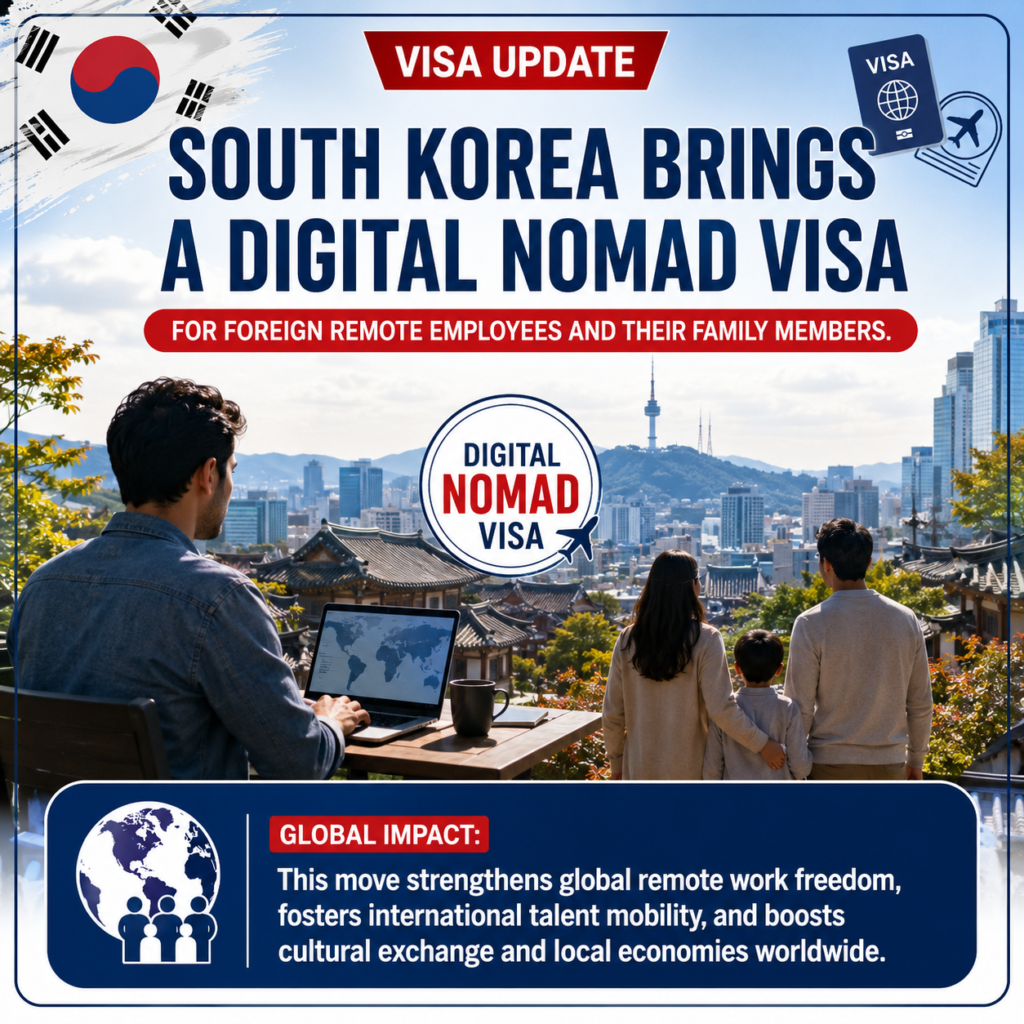
South Korea Brings a Digital Nomad Visa for foreign remote employees and their family members. South Korea has launched a permanent Digital Nomad Visa that lets qualified foreign remote employees live in the nation while still working for an employer or company located outside.
Officially known as the Workcation Visa, the initiative first started on a trial basis on January 1, 2024. After more than two years of testing, South Korea made the visa permanent on June 30, 2026.
Eligible digital nomads can stay in South Korea for a maximum of three years under the permanent program. The previously permission is to stay of up to two years, with an initial one-year visa that could be renewed for another year.
Who is eligible to apply for South Korea’s Digital Nomad Visa?
The visa is meant for those foreign nationals who have their companies running in abroad or work remotely from outside South Korea for businesses. Applicants have to be at least 18 years old and have one year of experience in their area.
Furthermore, they have to fulfill minimum income standards established by the South Korean government. Applicants had to have yearly income equivalent to two times South Korea’s per capita Gross National Income under the initial regulations. The permanent program, meanwhile, has loosened the income criteria for some candidates.
Younger candidates and those intending to live outside major metropolitan areas or in areas experiencing population loss could qualify with annual income equal to one-time South Korea’s per capita GNI instead of twice the amount.
The adjustment might encourage foreign remote workers to live outside the major metropolitan centers and help to make the visa more available.
Necessary Documents
Necessary Documents for the Workcation Visa. Applicants have to show proof of income and employment level. This covers employment verification letters and payroll data. They, too, have to turn in a criminal history report with a spotless record. Another need is private health insurance. The policy has to cover at least KRW 100 million.
Applicants bringing family members must also present evidence of their connection, such marriage or birth certificates. Family members can even relocate to South Korea. Qualified digital nomads can bring their closest relatives with them.
Under the initiative, legal partners and unadopted kids under 19 can travel with the primary visa holder. This lets remote employees move to South Korea without having to leave their immediate relatives behind.
How to Add
Candidates are usually required to provide their documents at a South Korean embassy or consulate in the country where they currently live, and have it verified by them. After reviewing the application, if it meets all these criteria, then the diplomatic mission will issue visa. Digital nomad visa holders have to seek a residence card once they get to South Korea.
Sometimes, visitors from other countries already in South Korea under B-1 or B-2 visa waiver status or a C-3 short-term guest visa may be able to convert their status to the Workcation Visa. Applicants are often advised to use the consular application procedure when feasible, though.
Can digital nomads find work at Korean businesses?
Workcation Visa holders are not permitted to work for a South Korean company on a regular basis. Individuals with visas have to keep working remotely for their foreign company or company. They are also barred from making money from local for-profit activities in South Korea unless they get the right immigration status.
The Digital Nomad Visa allows international remote employees a specific immigration path to live in South Korea while maintaining their employment abroad. With the program permanent and the maximum stay raised to three years, South Korea is setting itself as another long-term home for foreign distant employees.