
Kenya describes, how Its new obligatory travel insurance requirement, will really apply.
Kenya clarifies mandatory travel insurance: Home-country policies accepted if they meet $50,000 in specific categories. ETA verification coming soon. What you need to know.
If you’re going to Kenya, there’s a new form coming your way. The government just gave visitors a much better idea of what it will include.
A clarification statement was issued by the Ministry of Health in Kenya on August 7, 2026, clarifying issues raised by Gazette Notice No. 11492, Visitors won’t be made to purchase a brand-new Kenyan insurance policy from start, according to the main message. Rather, coverage bought back home can count as long as it satisfies Kenya’s particular requirements; therefore, guests must show it during the electronic travel permission (ETA) application process.
Years in development this Rule Has Been
Mandatory travel medical insurance for visitors from other countries is not a novel concept in Kenya. Its legal roots go back to the Social Health Insurance Act of 2023. Section 26 of that statute mandates that any non-Kenyan intending to remain in the nation for under 12 months carry travel health insurance meeting criteria established by the Health Cabinet Secretary.
Building on that foundation, the Social Health Insurance Regulations of 2024 said that guests have to show up with insurance already arranged or, if not, be able to get it right at the border. Beginning in May 2025, officials from the ministries of health and immigration started alignment on enforcement tools. The document finally confirmed the real dollar amounts travelers and insurance providers have to fulfill: Gazette Notice No. 11492.
The Coverage Data You Need to Be Aware Of
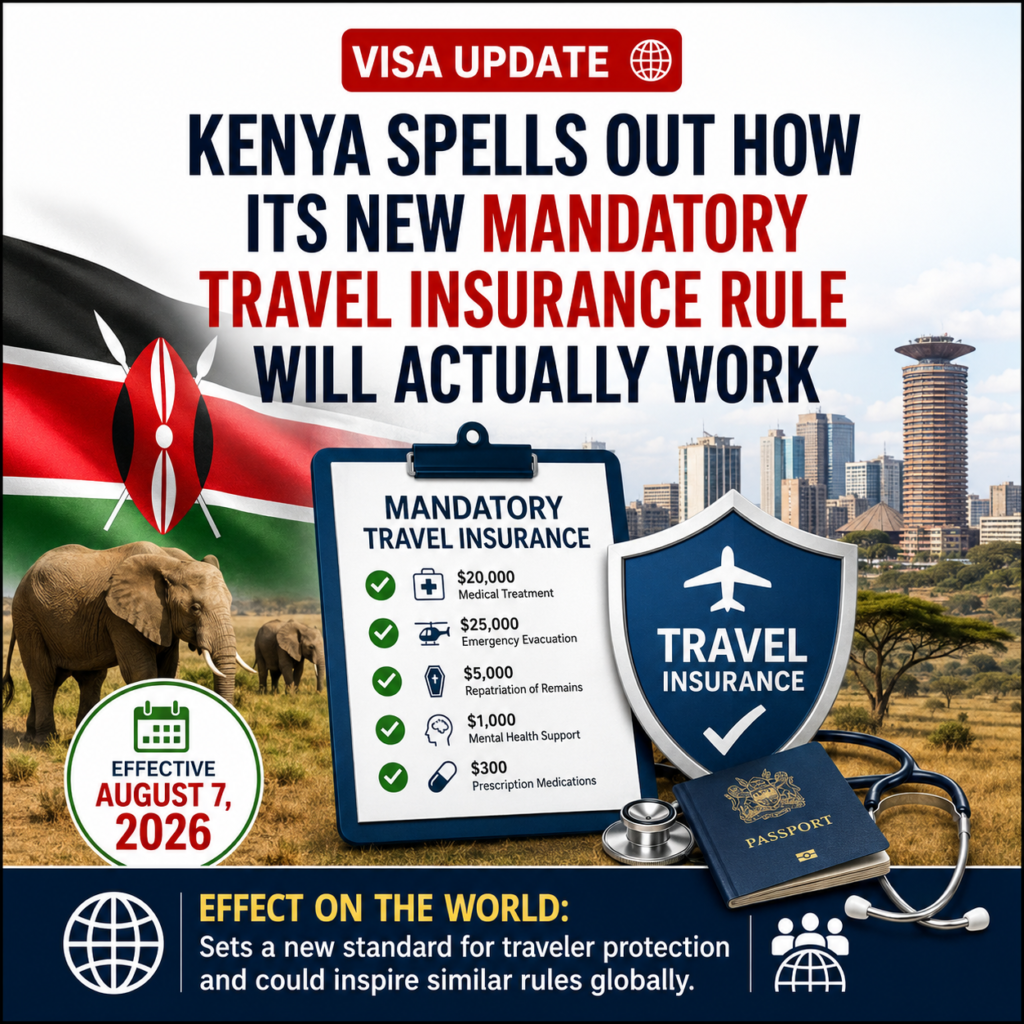
New guidelines require travelers to have a combined minimum of $50,000 in coverage spread across particular areas instead of one overall amount:
- Medical care costs $20,000.
- Emergency medical evacuation costs $25,000
- Repatriation of remains costs $5,000.
- $1,000 for mental health help
- Prescription meds cost $300
Though these numbers reflect the floor, not a price tag, insurers are free to provide more generous limits. A policy, most importantly, has to meet every personal need; a $50,000 general travel insurance that lacks psychiatric or evacuation coverage may not actually qualify even if its overall limit seems adequate on paper.
Good News: Your Current Policy Could Be Enough
The ministry’s statement’s most comforting aspect is perhaps Kenya’s departure from Zanzibar’s style whereby guests usually must purchase insurance right from a nearby company. Instead, Kenyan officials claim a policy bought in your home country is valid as long as it fits the standards presented in Gazette Notice No. 11492.
Anyone already carrying yearly insurance, credit-card-linked travel coverage, or another foreign plan will find this to be a significant difference. The catch is that before presuming they are covered, visitors will need to check that their current plan covers every one of Kenya’s particular coverage areas, having insurance is not always sufficient.
The Role of ETA in the Process
Travelers who need an ETA to visit Kenya will get their insurance confirmed before they ever get on a plane. Applicants will have to submit verification of a qualifying policy along with their ETA application so authorities could check compliance in advance. The Department of Immigration Services in Kenya will oversee this process by means of spot checks at entry points as well as by the ETA platform.
But the system is still not fully operational. Presently, the official ETA website for tourism, exhibits only the essential criteria: passport particulars and photos, contact information, travel plan, and proof of accommodation. That list doesn’t include insurance, and the ministry hasn’t said a set date for when the uploading criteria will become active.
What If You’re Not Covered by the ETA?
Not every Kenya traveler needs an ETA; the official ETA portal provides information on many excused nationalities and trip types. But exemption from the ETA does not indicate total exemption from the insurance criteria. Regardless of ETA status, the Ministry of Health’s language addresses all non-Kenyans living less than 12 months.
The statement validates that immigration officers would search for appropriate insurance at entry points in general but falls short of detailing how ETA-exempt travelers should present their proof of coverage. That information is still to be determined right now.
Didn’t Remember to Purchase Insurance? There is a backup strategy.
Those that arrive without a qualifying policy are not said always unlucky. The rules let one buy insurance on the spot from a provider approved to sell this kind of coverage under Kenya’s Insurance Act. Then immigration officers will have to verify the policy satisfies standards before approving entrance. This on-arrival choice is already included into Section 70(3) of the 2024 Social Health Insurance Regulations.
The Bottom Line
Though still under development, Kenya’s required insurance requirement is becoming more clear. Travelers going to Kenya in the next several months would be wise to review their current travel insurance against the particular dollar amounts in Gazette Notice No. 11492 and to check the ETA site for updates on when official proof of coverage becomes part of the application.
For More Information, contact your country/regional embassy.