
Kazakhstan offers visa-free entry to 85 nationalities with stays ranging 14–90 days. Learn the rules by citizenship before you book.
Update on Kazakhstan ETA and visa rules
It’s time for an update if you were organizing a trip to Kazakhstan. Visa-free entry may no longer mean no paperwork. Kazakhstan is rolling out a kazakhstan paid electronic travel authorization that will require submitting an application and payment before travel.
The system is live in a limited, optional version. Moreover, a formal legal framework is moving through approval and will make it compulsory in phases.
A fresh rule is forming
Kazakhstan’s Ministry of Internal Affairs posted a draft law for public examination on the nation’s official Open NPA website on July 31, 2026. A formal procedure for providing electronic travel permits to foreign nationals and stateless individuals would be included in the proposal, which would modify entry and exit laws that have been in place since 2012. The government intends to implement the new system gradually from August to December of this year, after the consultation period ends on August 17, 2026. Prior to the regulation’s widespread implementation, that timeline enables authorities to develop the technology, train border guards, and handle logistics.
What has not yet been resolved, at least publicly, is equally crucial as what has been decided. Kazakhstan has not revealed the expense of the ETA, which countries will eventually be required to get one, or the precise start date of the need for every group of visitors.
The Current Operation of the System
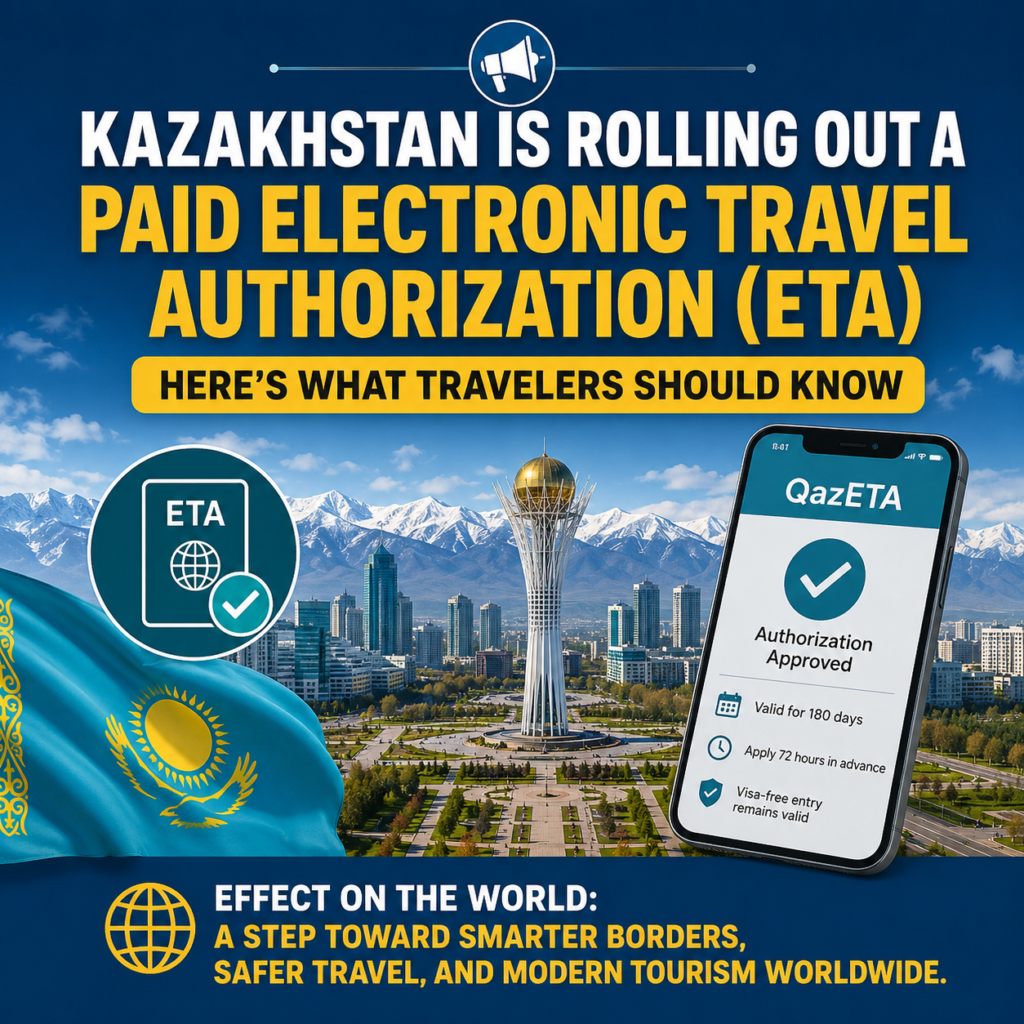
An app named QazETA, accessible on iOS and Android, is managing the ETA. It’s currently in pilot mode: visitors from visa-exempt nations are urged to apply, though it’s not yet required.
Crucially, this is an additional layer on top of Kazakhstan’s visa-free regime rather than a replacement. travelers, who already have permission to enter visa-free will retain that right. Kazakhstan Is Introducing a Paid Electronic Travel Authorization.
Kazakhstan paid electronic travel authorization
Kazakhstan’s Ministry of Internal Affairs posted a draft law for public examination on the nation’s official Open NPA website. It was dated July 31, 2026. Additionally, a procedure for providing electronic travel permits to foreign nationals and stateless individuals would be included in the proposal.It would modify entry and exit laws that have been in place since 2012.
Prior to the regulation’s widespread implementation, that timeline enables authorities to develop the technology, train border guards, and handle logistics. What has not yet been resolved, at least publicly, is equally crucial as what has been decided. Kazakhstan has not revealed the expense of the ETA, which countries will eventually be required to get one, or the precise start date of the need for every group of visitors.
The current operation of the system is managed by QazETA, an app available on iOS and Android. In pilot mode, visitors from visa-exempt nations are urged to apply. However, applying remains not yet required. Note that the kazakhstan paid electronic travel authorization remains optional. Crucially, this adds a layer on top of Kazakhstan’s visa-free regime. It is not a replacement. travelers who already have visa-free permission will retain that right.
They will just have to obtain electronic clearance ahead of time, a system much like Canada’s eTA or the ETIAS system in Europe. Under the pilot program’s present rules, applicants are required to apply at least 72 hours prior to their trip, and the permission remains valid for 180 days from the date of issuance. That six-month window is merely how long the permission itself is valid; it does not increase how long a person may really remain in the nation.
How long to stay
The length of stay will still be determined by the visa-free allowance that is already granted to that visitor based on their passport. And even with an approved ETA in hand, border officers at the airport or crossing point still make the final entry decisions. Yes, there will be a cost.
On June 24, 2026, Kazakhstan passed Law No. 326-VIII, which establishes the legal foundation for a paid electronic permission, issued by organizations under the Ministry of Internal Affairs with input from national security organizations, the law defines it as an official digital record verifying that a traveler has been approved to enter or travel through the nation.
Although the precise cost has not been determined, the law specifies where the funds will be used, a portion will support improvements to Kazakhstan’s digital border-control infrastructure, and the remainder will be allocated to tourism development projects. Thus, this is not a universal admission charge for every international visitor; rather, it is directly related to the expense of handling the electronic clearance for visitors who require one.
Under the pilot program’s present rules, applicants are required to apply at least 72 hours prior to their trip, and the permission remains valid for 180 days from the date of issuance. That six-month window is merely how long the permission itself is valid; it does not increase how long a person may really remain in the nation.
Yes, there will be a cost
On June 24, 2026, Kazakhstan passed Law No. 326-VIII, which establishes the legal foundation for a paid electronic permission. Issued by organizations under the Ministry of Internal Affairs with input from national security organizations, the law defines it as an official digital record verifying that a traveler has been approved to enter or travel through the nation.
Although the precise cost has not been determined, the law specifies where the funds will be used: a portion will support improvements to Kazakhstan’s digital border-control infrastructure, and the remainder will be allocated to tourism development projects. Thus, this is not a universal admission charge for every international visitor; rather, it is directly related to the expense of handling the electronic clearance for visitors who require one.
What takes place on August 25?
The bulk of the clauses in the amended legislation come into force 60 days following its first announced publication, which was planned for August 25, 2026. But that date just signals Kazakhstan’s formal approval to begin distributing paid ETAs, do not confuse it for a strict deadline. It does not imply that on that day every visitor without a visa suddenly needs one.
Before the need can genuinely apply to some nations, Kazakhstan still has to clear up many facts: which nationalities are included, whether any exemptions or grace periods will apply, delayed starting dates by country, the actual cost, how long processing will take, and the circumstances under which an application may be refused or canceled. Along with authorized diplomats and official delegations, diplomatic and official passport holders are expected to be fully free from the requirement.
Whose Consequences Would Be Felt?
Legal stays in Kazakhstan vary from 14 to 90 days, depending on citizenship and reciprocal agreements, at the moment, citizens of 85 countries and territories are allowed entry without a visa. The pool of guests who might ultimately be requested to get an ETA is represented by that group most of Europe, North and South America, parts of Asia, and close Central Asian and CIS nations. Recall that this is a potential list, not a definitive one; the ultimate introduction might apply to just a portion of these nations or provide different schedules for every one.
This change also corresponds with a more general regional trend. Kazakhstan has independently said it supports a suggested single Central Asian tourist visa, a concept recently advanced by Kyrgyzstan and supported by Uzbekistan, therefore indicating the area is reevaluating how it handles cross-border travel more generally.
The Bottom Line
For visitors, nothing immediately changes. Though Kazakhstan is still sorting out the specifics, the ETA remains voluntary and compulsory implementation won’t start until certain guidelines are established this year. Still, official updates should be watched by anyone arranging a trip in the second part of 2026, what is now a free, fast process via QazETA is on course to be a paid, mandatory stage before departure.
For More Information contact with your regional/ Local embassy.