
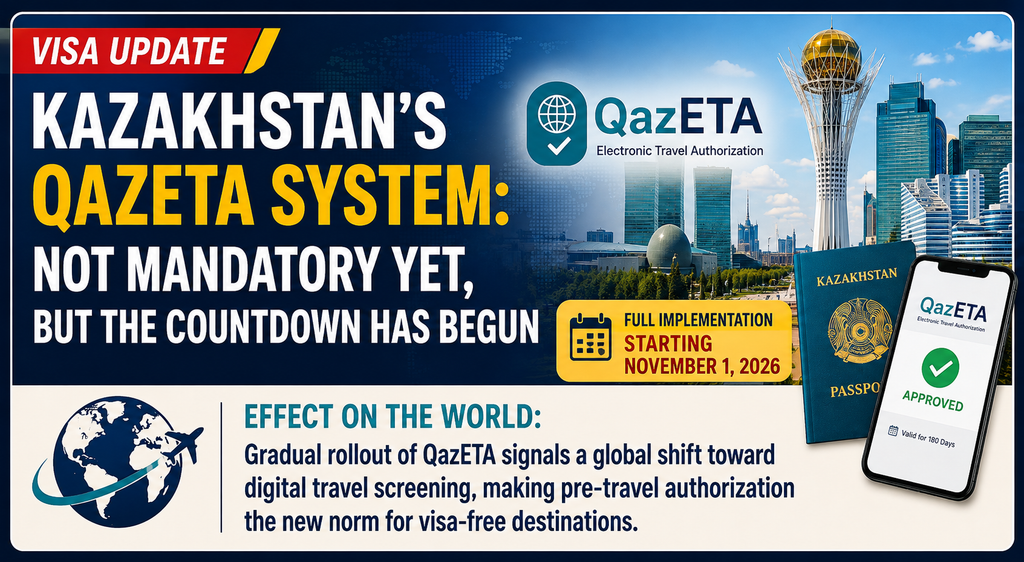
Even if the system is not yet at the stage where it is required to cross the border, Kazakhstan entry requirements 2026, is getting closer to needing an electronic travel authorization for visitors from other countries. Several sources now detail a transition period through November 1, 2026, after which the need will be progressively implemented based on how passengers arrive.
Right now optional, not required
In spite of contrary claims, Kazakhstan’s QazETA approval is still voluntary for the time being. Qazinform, the state news agency said on September 1 2026 that the qazeta.kz website is still running as a test project. This means people, from countries that do not need a visa can ask for permission but are not required to do yet.
The French Embassy in Kazakhstan has said the system is being put in place gradually starting on August 24 2026 and that matches what is being said. In terms the country is slowly leading visitors toward the new system rather than making changes all, at once.
A Five-Phase Rollout Is Developing
Serbia’s Ministry of Foreign Affairs has released the most clear timeline yet, detailing a phased schedule for when QazETA will be required at various sorts of border crossings.
That timetable suggests that visitors may still enter without permission until November 1, 2026. Enforcement then will go as follows:
| Target Date | Applies To |
|---|---|
| November 1, 2026 | International airports |
| November 15, 2026 | Land borders with non-EAEU countries |
| November 30, 2026 | Land borders between Eurasian Economic Union member states |
| December 15, 2026 | Rail and sea crossings |
Airlines will have to check that passengers have a QazETA before letting passengers board after the airport phase starts. Passengers, without a QazETA may be turned away at check‑in instead of at Kazakh immigration. Airlines need to verify the QazETA.
It’s worth highlighting that no official Kazakh law confirming this precise timetable has been made public thus far. Based on several government sources, the dates should be regarded as extremely likely; nevertheless, they are not absolutely fixed until Kazakhstan publishes its own implementing legislation.
Travelers Claim Easy Entry Not Requiring QazETA
Real-world observations support the theory that enforcement has not begun. One tourist posted on social media that they went into Kazakhstan without having QazETA permission, exhibiting a passport stamp dated August 29, 2026, as evidence.
Although one tale does not constitute formal proof of policy, it does validate that border officials are not presently rejecting visitors who lack the permission.
Who Will Need It, and Who Is Exempt?
Among the different countries whose people already have visa-free entrance to Kazakhstan are France, Belgium, Switzerland, and Canada. QazETA is meant for citizens of these countries. Crucially, the authorization adds a pre-arrival screening stage atop visa-free travel; it does not replace it, and the current limitations on duration of stay are unaffected.
Some groups are expected to be exempt completely, among them
- Those having a legitimate Kazakh visa
- Foreigners who have either temporary or permanent residence permits.
- Official and diplomatic visitors
- Passengers in route not officially entering the nation
Age-based exemptions provide some uncertainty. The official QazETA FAQ says in one section that children under 16 do not need an authorization, but another list of exempt categories on the same page mentions individuals under 18 and those 65 or older. The exact cutoff age for minors is unknown until Kazakh authorities either clarify this discrepancy or publish last rules.
Costs, Time, and Legitimacy
Applicants should have to submit their request at least 72 hours prior to arrival. Once granted, the permission is good for 180 days and enables several entries during that period.
According to Qazinform, submitting in advance is anticipated to cost around 3,900 tinge (about $8), while those who show up without one may be able to buy it right there at the border for somewhere between 7,600 and 7,800 tinge (roughly $14–16), figures that closely match Serbia’s stated estimates.
But since airlines are expected to check for a legitimate QazETA before boarding, it’s still unclear how frequently border-issued clearances will really be offered after the airport phase starts on November 1. That might render on-arrival purchases much less convenient for air tourists than for those traversing by land.
The Steps of the Application Procedure
QazETA works using a special mobile app offered on Google Play and the App Store. Applicants enter their passport information and pass an identity check.
Tests performed in late August 2026 revealed that before the program connects the document to an account, the process now entails users snapping a photo of their passport’s bio-metric page and then utilizing NFC or RFID to scan its embedded chip.
The system’s FAQ also suggests that travel agencies or other third parties might be able to register documents on behalf of a traveler, even if the precise methods for group applications or authorized submissions have not been fully specified yet.
The Bottom Line
Although QazETA is live and working, it has not yet become a mandatory condition for entering Kazakhstan. Officials continue to refer to the present phase as a pilot phase, and both government guidance and travel statistics show that arriving without the approval remains feasible for the time being.
Having said that, the writing is on the wall: airports are planned to demand QazETA beginning November 1, 2026, with other entry stations following through mid-December. Travelers arranging visits to Kazakhstan in the upcoming months ought to keep an eye on official channels as Kazakhstan’s final implementing legislation, which would fix these dates and costs, has not yet been released.
For more Information contact with your regional embassy!