
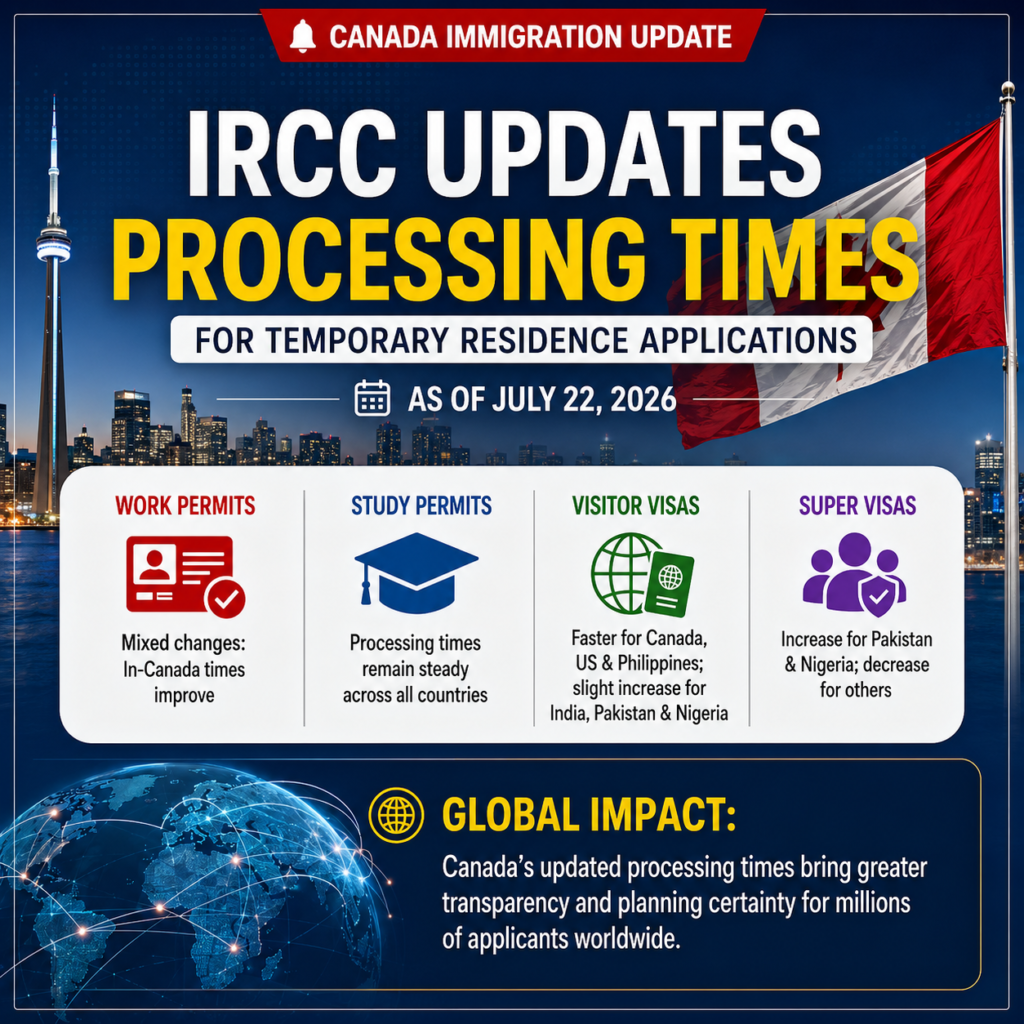
Released by Immigration, Refugees and Citizenship Canada (IRCC), revised statistics as of July 22 show the projected processing times for several temporary residence application forms.
The most recent statistics from the immigration department show modest activity in a number of areas, driven by variations in work permit waiting times, arrange a free work permit consultation.
The most obvious adjustments to processing times noted in this update include:
- Work permit : Three more weeks for Pakistan, one week for the Philippines;
- Visitor visa : Five-day reduction for In-Canada submissions
- Super visas: five-day extension for the Philippines.
For any of the five nations highlighted below, study permit waiting periods showed no variations.
This article looks at changes in processing times for recently submitted temporary residence applications between July 15 and July 22. Canada’s immigration website is expected to be updated with new temporary residence processing times around July 29, 2026.
Travel permits
While Pakistan and Philippines had waiting times increase, work permit application processing times filed from within Canada still get better.
Applying from: Current (July 22); Previous (July 15).
Canada: 122 days; 124 days
India: 9 weeks; 9 weeks
Pakistan : 10 weeks ; 7 weeks
Nigeria: 6 weeks; 6 weeks
United States : 3 weeks ; 3 weeks
Philippines: 7 weeks, 6 weeks
Benchmarks for service:
- Canadian submissions (initial and extension): 120 days
- Non-Canada submissions: 60 days
Work Permits
Over the last four weeks, study permit processing times for every one of the nations indicated below have stayed steady, showing neither growth nor decrease.
Application from: Current (July 22); Previous (July 15).
- Canada: seven weeks. : seven weeks
- India : five weeks. : five weeks
- Pakistan : six weeks. : six weeks
- Nigeria: Six weeks. : six weeks
- United States: five weeks : , five weeks
- Philippines : four weeks. : four weeks
Service standard:
- In-Canada submissions (initial and extension): 120 days
- Submissions outside Canada: sixty days
Visitor visas
Applications for visitor visas filed from Canada, the United States, and the Philippines had better processing times, while estimates for India, Pakistan, and Nigeria somewhat increased.
Submitting from: August 22 Current; August 15 Previous
- Canada: 29 days ; 34 days
- India: 21 days. ; 20 days.
- Pakistan : 40 days. ; 39 days
- Nigeria: 63 day. ; 61 days
- United States: 27 days; 28 days
- Philippines : 16 days. ; 17 days
Service criterion:
- Canada submissions: Not Applicable
- For contributions outside Canada: 14 days
Super visas
Led by a seven-day rise for Pakistan, super visa application times for Pakistan and Nigeria surged, candidates from the other nations had shorter wait times.
From: Current (July 22); Previous (July 15)
- India : 50 days ; 49 days
- Pakistan: 194 days ; 187 days
- Nigeria: 39 days; 36 days
- United States: 124 days; 126 days
- Philippines : 68 days : 73 days
Service Criterion: 112 Days
Applications for super visas cannot be made inside of Canada. Realizing service standards and processing times. Applicants might check IRCC’s stated processing times for a rough estimate of how long it could take to complete an application for permanent residence, temporary residence, or citizenship.
These data are meant mostly as general direction and provide no assurance that an application will be finished inside the stated deadline.
The department makes two kinds of estimates:
- Based on the time needed to finish 80% of applications submitted in the past, historical processing times vary.
- Forward-looking processing times: determined from IRCC’s current application load and capacity.
Service expectations are intended for another goal. Internal performance targets, they show how quickly IRCC hopes to complete a specific application type under typical circumstances, usually including 80% of applications.
The time needed to process one application could vary from the estimate as well as the service standard. The ultimate timetable might be impacted by case complexity, backlogs, operational capability, extra document demands, and more review criteria.
Normally weekly updates of temporary residency processing times and monthly updates of permanent residency and citizenship estimates are given by IRCC. Service standards are less often evaluated, those for temporary residence applications last changed in 2018–2019.