
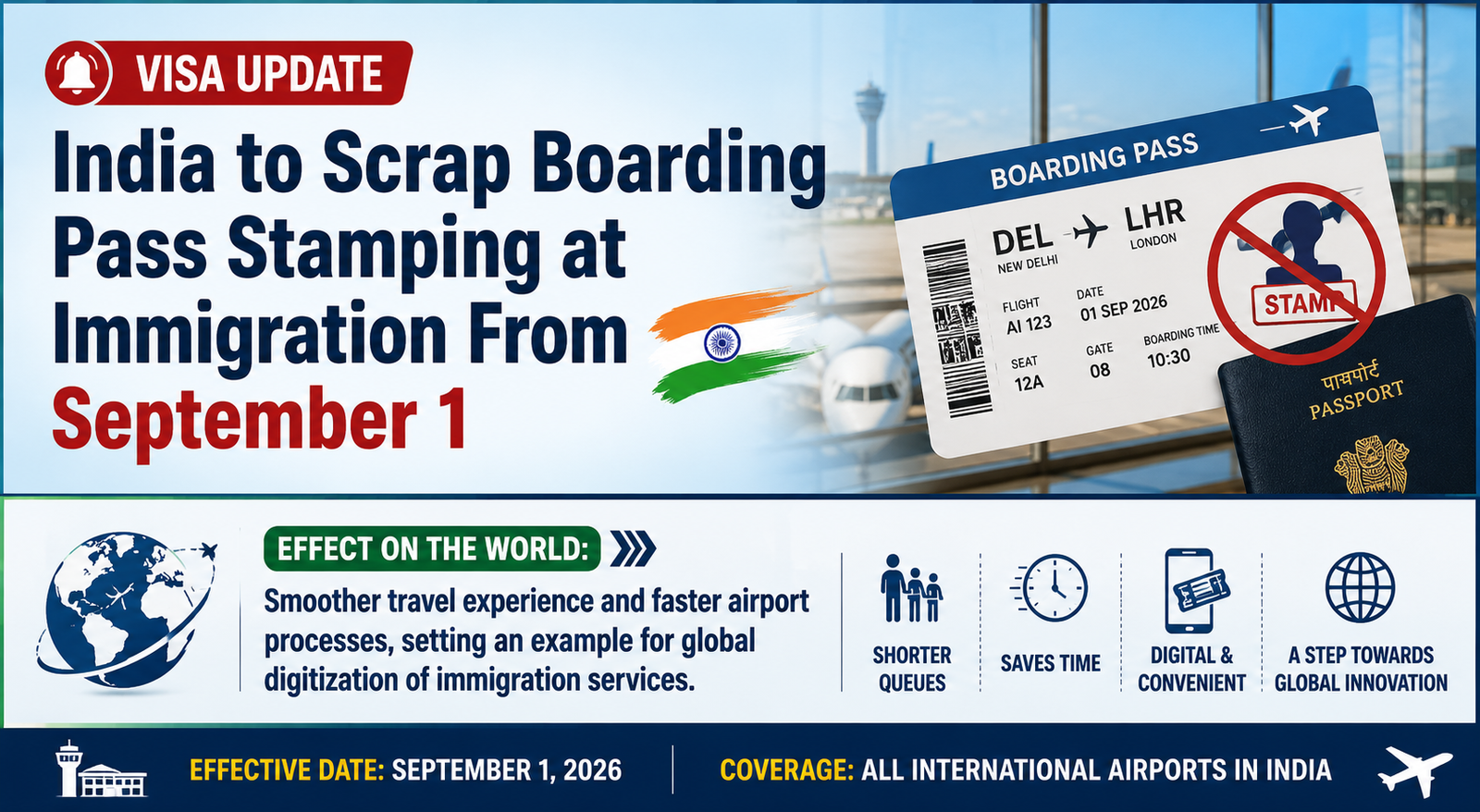
The airports in India are phasing out still more paperwork.
Starting September 1, 2026, travelers on international routes won’t need stamping by immigration officers under India airport departure rules 2026. This is a minor but significant change.
It affects how departure formalities operate at every international airport in the nation. The Bureau of Immigration (BoI) is under India’s Ministry of Home Affairs and handles immigration enforcement. It is the source of the modification.
An internal order for airport operators, airlines, and security personnel describes changes to the boarding stamp practice at immigration. India airport departure rules 2026 are driving its gradual elimination across the country.
Why India Is Dropping the Stamp
The choice was carefully considered. Officials looking at the procedure discovered that hand stamping was causing more issues than it was solving. Sometimes people put stamps on boarding passes at angles. Times they use too much ink or not enough ink. This can cover up the bar-codes or the parts that machines need to read. When this happens it causes confusion and slow boarding times. It is also very annoying, for passengers. Most passengers are already juggling a phone, a passport and hand baggage while walking through the terminal. I see how passengers feel when a boarding pass refuses to scan. That the thing to be a worried about.
Reports identified Deepak Yadav, a senior officer at the Delhi Foreigners Regional Registration Office (FRRO), as the one behind the order setting the transformation going. According to those accounts, the reasoning came down to two practical problems: unnecessary bother for passengers and reading errors generated by erratic stamping.
Interestingly, this isn’t the first time a security group has quietly stepped back from checking boarding passes. A time ago the Central Industrial Security Force, which checks passengers physically at Indian airports stopped stamping boarding passes. The CISF no longer puts stamps on boarding passes.
Immigration officials are nowadays acting according to the same reasoning.
What Travelers Really Experience
The upgrade eradicates an ancient rule rather than introducing a fresh one. Passengers leaving India on overseas flights may display their electronic boarding pass on their smartphone at the immigration counter from September 1 onward; no printing is required for stamping.
travelers who still like paper boarding passes are included. At immigration stations across the nation, physical boarding passes will still be welcomed; they just won’t be returned with a stamp on them any longer. In essence, nothing is being imposed; rather, a stage is being removed.
Regular travelers registered in India’s Fast Track Immigration, Trusted traveler program (FTI-TTP) will also experience the advantage reaching the automated e-gates utilized under that system, whereby electronic boarding passes will now operate flawlessly.
There are early indications that India’s immigration officials may be reevaluating physical stamping more generally, beyond simply boarding passes. Some stories indicate a pilot program looking into the removal of entry and exit stamps in passports for Indian citizens, therefore implying the BoI’s digitization drive might not end at the departure desk.
India’s entry regulations stay unaltered
This update does not affect the overall scope. There has been no change in India’s entry requirements for visitors from abroad. As a note, India airport departure rules 2026 remain unchanged for departing travelers.
The e-Arrival Card, a digital replacement for the outdated paper arrival form that becomes required on October 1, 2025, is also unaffected. Visitors have to finish it online within 72 hours of coming either via the official Indian Visa Online gateway, the Bureau of Immigration’s website, or the Indian Visa Su-Swagatam mobile application.
This change likewise has no impact on health screening methods. On June 25 2026 India brought back its Air Suvidha health declaration system. This system was. Now has a new name, Air Suvidha 2.0. As part of a plan to watch more closely at places where people enter the country travelers coming from outside India can now complete this declaration online. They can do this, up to 24 hours before they arrive.
The Wider Scope
Taken together, these developments point to a consistent, albeit gradual, upgrading of India’s border management, reducing physical contact points at departure while strengthening digital systems for arrival. For the average traveler, the practical conclusion is straightforward: starting September 1, one less queue-and-stamp interaction separates you from your gate, regardless of whether you’re checking in with a phone or a paper printout.
Like with most bureaucratic simplification, the actual test will be in execution, how regularly the new strategy is applied throughout India’s dozens of international airports, and if it stands up under heavy travel. But for now, it’s a pleasant bit of friction gone from one of the busiest air transportation hubs worldwide.