
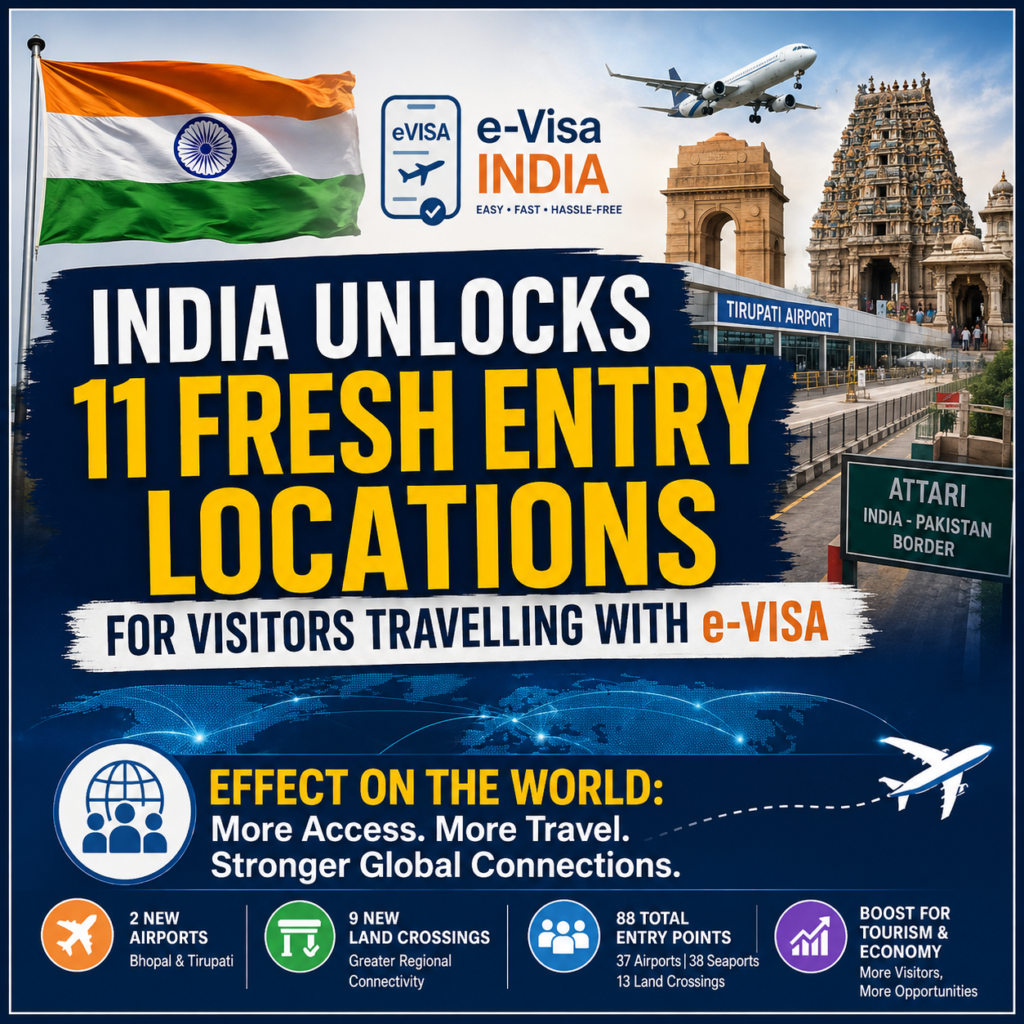
It has become a little simpler to plan a trip to India. The Ministry of Home Affairs of the nation has introduced eleven more entry sites for tourists utilizing an electronic visa (e-Visa), therefore providing visitors greater leeway in where and how they enter the nation. The update, which was made on August 10, 2026, adds two airports and nine land border crossings to the current network, bringing the total number of approved e-Visa entry points to 88.
An Expanding Network of Airports, Seaports, and Land Crossings
India’s e-Visa system now encompasses 37 airports, 38 seaports, and 13 land border checkpoints across the country with this most recent growth. From where the initiative began only over ten years ago, that is a sizable increase that mirrors a larger effort by Indian authorities to increase national accessibility for foreign tourists.
Two New Airports Join the List
E-Visa users can now access their registration information from Bhopal, the capital of Madhya Pradesh, and Tirupati, a pilgrimage center in Andhra. Now e-Visa users can go to Bhopal and Tirupati which means they do not have to travel through cities to get to central India and famous religious places like Tirupati.
This is a thing, for visitors who want to visit central India and go to e-Visa users who want to see the famous religious tourism circuit.
Nine Land Crossings Now Accessible to Those with e-Visas
However, the more important change happens along India’s land borders. New crossings: Agartala, Darranga, Gede (annam.) Ghojadanga), Haridaspur, Jaigaon, Dawki, Moreh and Attari (Road).
The border crossings of Agartala, Gede, Ghojadanga and Haridaspur and Dawki connecting India and Bangladesh. Jaigaon and Darranga are situated along roads that enter Bhutan. Moreh sits along the Myanmar frontier. Attari is still the main road crossing connecting India and Pakistan. This longer list might significantly streamline overland travel arrangements for anybody organizing a regional South Asia trip.
A Minor Wrinkle in the Announcement
Not everything in the official update lines up perfectly. In the government’s released list, Darranga is mentioned twice, once among the four existing land entry points (along with Raxaul, Rupaidiha, and Jogbani) and then once again in the newly added section. The catch is that Darranga was added to the e-Visa system back in March 2026, months before this most recent announcement.
That duplication appears to be a clerical error rather than a genuine policy aspect. It leaves two options on the table, either the actual expansion comes to 10 new sites (the two airports plus eight really new land crossings), or a ninth crossing was intended to be mentioned instead of Darranga and just got left out. The precise number is still somewhat debatable until the Ministry provides clarification.
The Official Portal Has Not Caught Up Yet.
Travelers anxious to utilize one of these fresh entry points should wait until they are sure everything is functioning. India’s official e-Visa application gateway has not yet been changed to mirror the developments as of this writing. The portal’s current list of permitted entry locations exclude Bhopal, Tirupati, and the recently added land crossings. Notably, Darranga is currently included there in accordance with its prior March expansion, not the August declaration.
Although this delay between a policy release and a system update is fairly frequent, it serves as a helpful reminder to review the official portal before completing travel plans, particularly if a new entry point is essential to your path.
The Larger Picture of the e-Visa
This most recent change belongs to a far longer trend. India’s integrated e-Visa and Electronic Travel Authorization (ETA) system, which was introduced in 2014, was open to residents of only 43 nations. At 172 today, that number represents a fourfold rise that brings a simplified, online application procedure within reach of most of the world’s tourists.
Additionally, the program has grown in scope well outside basic travel. It currently covers everything from mountaineering and medical visits to business travel, academic study, transit, cruise ship group travel, and a number of other uses throughout 17 subcategories.
The statistics speak for themselves: around 78% of all visas India grants now are electronic, and almost 95% of e-Visa applications are handled within 72 hours. What started as a small test project has evolved into the primary method for foreign nationals obtaining permission to enter India.
Things Travelers Should Keep in Mind
Visitors must complete two further processes prior to arrival, in addition to obtaining an e-Visa, the e-Arrival Card, which has to be completed within 72 hours of arrival, and the Air Suvidha 2.0 health declaration, a requirement restored in June 2026 that visitors must submit before passing immigration.
The best course of action right now is to view this announcement as a preview of what’s to come instead of a completely finished policy. Close to your travel date, verify the official e-Visa website, make sure your planned entry point is listed, and include the e-Arrival Card and health declaration as regular pre-trip chores. Remaining current with the most recent portal changes will continue to be the most dependable approach to prevent surprises at the border as India expands its network of entry points.
More Information, visit your country/regional embassy to be aware of any new updates