
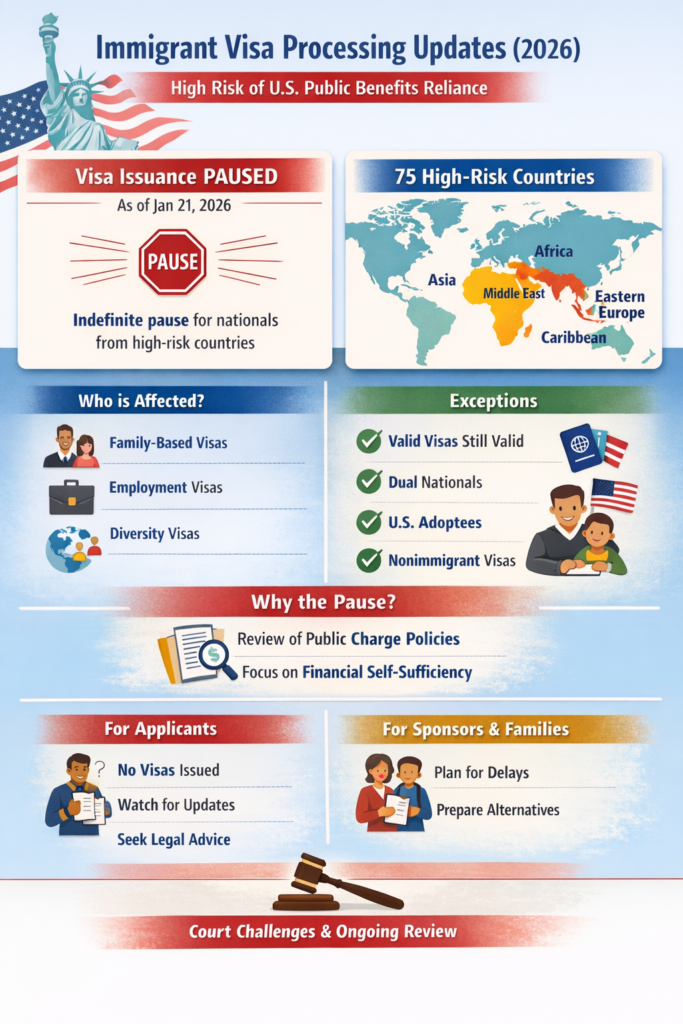
The U.S. Department of State (DOS) made a major policy change in 2026 affecting immigrant visa processing for certain nationalities considered at high risk of reliance on U.S. public benefits. These changes impact thousands of applicants and their families worldwide. In this comprehensive, SEO-friendly guide, you’ll learn what changed, who is affected, key exceptions, how it affects you, and what to do next.
What Is the 2026 Immigrant Visa Processing Update?
In January 2026, the U.S. Department of State indefinitely paused immigrant visa issuance for applicants from specific countries identified as high risk for potential reliance on public benefits. This pause affects visa issuance but not all aspects of the visa application process.
✔ Interviews may still be scheduled
✔ Applications can continue processing
✘ Final immigrant visas are not being issued until further notice
This policy aims to strengthen financial self-sufficiency standards and reduce future public benefits reliance among new immigrants.
Why Is This Policy Important?
Understanding these updates is essential if you or a family member is:
- Applying for an immigrant visa abroad
- Planning family-based immigration
- Sponsoring a relative for U.S. residency
- An employer arranging employment-based immigration
The policy alters how immigrant visa outcomes are determined and may create longer wait times for issuance.
List of Affected Countries (High-Risk Nationalities)
Nationals from certain countries are currently unable to receive final immigrant visa issuance until the policy is revised. The affected list includes, but is not limited to:
- South Asia: Afghanistan, Pakistan, Bangladesh, Nepal
- Middle East & North Africa: Iran, Iraq, Syria, Yemen, Egypt, Morocco
- Sub-Saharan Africa: Nigeria, Ethiopia, Somalia, Ghana
- Latin America & Caribbean: Guatemala, Brazil, Cuba
- Eastern Europe & Central Asia: Russia, Belarus, Armenia
This list may evolve as the Department of State updates policy guidance.
Key Exceptions to the Visa Issuance Pause
Despite the pause, certain cases may still proceed:
1. Existing Valid Immigrant Visas
If you already hold a valid immigrant visa, the policy does not cancel your travel authorization.
2. Dual Nationals
Applicants with dual citizenship can apply using a passport from an unaffected country if eligible potentially bypassing the current pause.
3. Case-by-Case Exceptions
Limited exceptions may exist for humanitarian reasons or under National Interest Exception rules, but these are not automatic.
4. Nonimmigrant Visas
Student visas (F, M), temporary work visas (H-1B, L-1), and visitor visas (B-1/B-2) remain unaffected by this pause.
How This Affects You: Practical Tips
If You’re Currently in Process
✔ Stay alert for official DOS announcements
✔ Maintain communication with your visa attorney
✔ Gather strong evidence of financial self-sufficiency
If You Plan to File
✔ Consider alternative pathways like nonimmigrant visas
✔ Check if dual nationality provides a route
✔ Prepare documentation proving financial capability
For U.S. Sponsors
✔ Prepare additional financial affidavits
✔ Be ready for longer processing timelines
✔ Advise relatives about potential pause impacts
Frequently Asked Questions (FAQ)
Q: Does this mean immigrant visas are banned for certain countries?
A: No — immigrant visa processing continues and interviews can happen. What’s paused is the final issuance of the visa until policy updates are released.
Q: Can I use a different passport to apply?
A: Yes — if you hold citizenship from a country not on the high-risk list, you may apply using that passport.
Q: Are U.S. green card holders affected?
A: Current U.S. permanent residents (green card holders) are not impacted by this immigrant visa pause.
Conclusion
The 2026 immigrant visa processing updates represent a major overhaul in how the United States approaches permanent residency for nationals deemed at elevated risk of public benefit reliance. With broad geographic impact and deep implications for immigration pathways, this development reshapes many families’ and employers’ plans, making awareness and strategic planning more important than ever.