
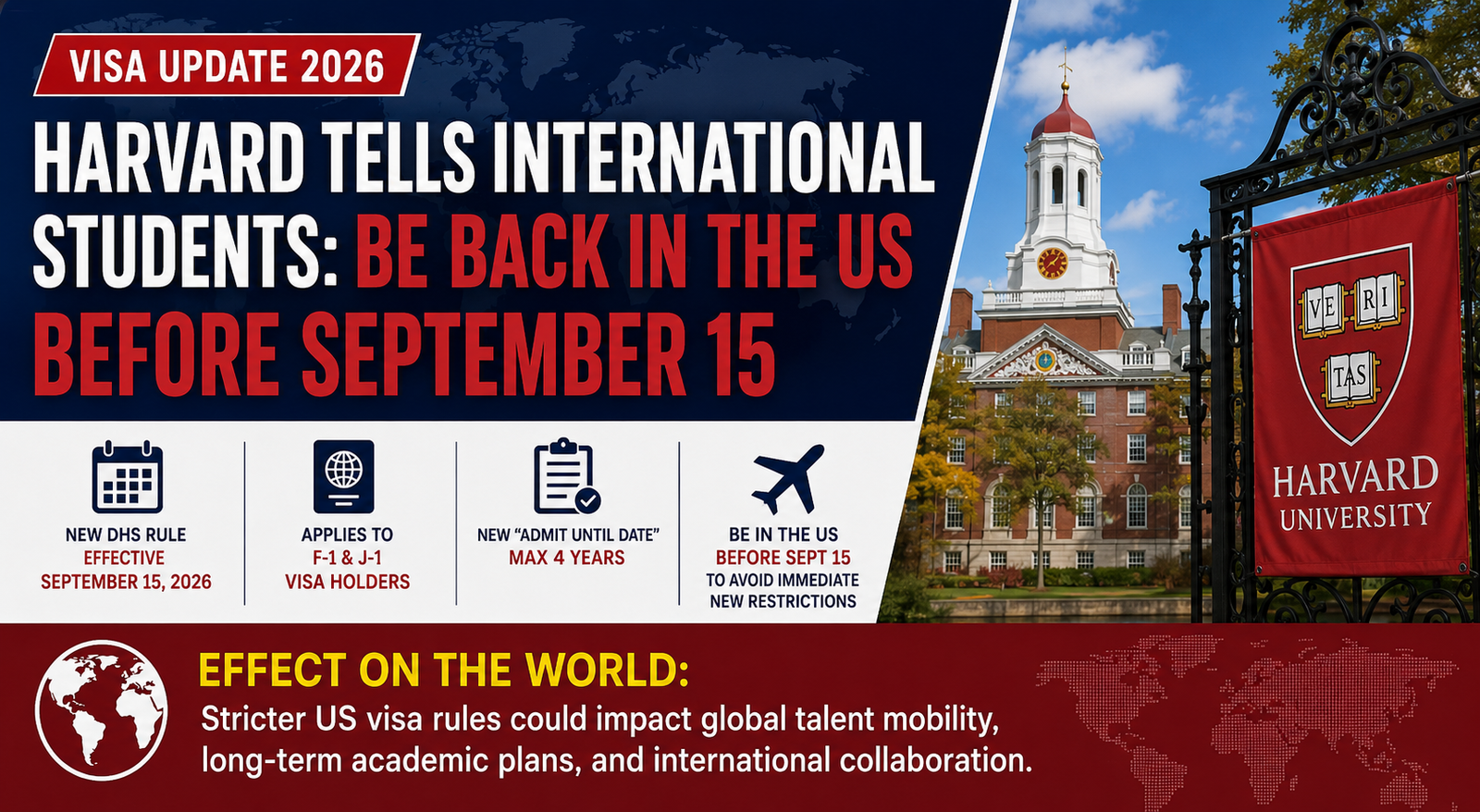
If you are a foreign student or researcher at Harvard, plan ahead. The International Office (HIO) of the university is now pushing F-1 and J-1 visa holders, along with the J-1 scholars joining campus this autumn, to be sure they are physically present in the United States before September 15, 2026. That’s the date a broad new Department of Homeland Security regulation takes effect and your location when it does can affect your immigration timetable for years to come.
What’s Actually Changing
International students in the United States have lived under a system known as duration of status, or D/S, for more than four decades. In simple words, it meant you could stay in the nation for as long as you remained enrolled and in good academic standing, no set expiration date stamped on your forms, just an open-ended runway connected to your program.
That runway is going to have a catastrophic halt. Published on July 17, 2026, the updated DHS rule would instead provide F-1 students and J-1 exchange visitors a particular Admit Until Date on their Form I-94. Though most people’s projected program completion date will coincide with that, it cannot surpass four years, irrespective of how long a degree, notably a PhD, really takes to finish. Anyone needing extra time will have to submit a formal Extension of Stay application with US Citizenship and Immigration Services, a process with paperwork, costs, and no assurance of approval.
Why September 15 Is So Important
The rule doesn’t affect everyone the same way on day one; this is the section confusing individuals. Students and researchers already within the US and keeping valid status on September 15 will have a softer landing. They can just carry on their current schedule till the latter of their program end date or the expiry of any post-completion work permission, limited four years from the effective date of the new regulations; they won’t need to submit anything right away.
What happens if you leave is the catch. Anyone who travels overseas, for a conference, a family visit, a vacation and tries to re-enter the US on or after September 15 will probably be processed under the new fixed-date system right away, regardless of transition safeguards. That one factor is what makes Harvard’s advice so specific: your physical presence in the nation when the clock begins seems to count more than your prior enrollment period.
It is predicted that the 60-day grace period for F-1 holders and the 30-day grace period for J-1 holders following the conclusion of a program will stay either way.
Who Thinks This the Most
For some pupils, the four-year limit is a greater concern than for others. Someone finishing a one-year master’s course has little cause for anxiety. But PhD candidates, whose programs usually last five or six years, are facing a policy that doesn’t quite match their intellectual schedule. Several Harvard graduate students have told campus media that they still don’t know how reentry after September 15 would really impact them if their course just can’t finish in four years.
The rule further limits other flexibility that international students have depended on for years. For instance, F visa graduate students would be prohibited from changing their major or moving institutions without first obtaining a federal waiver; another illustration of how the new system exchanges flexibility for structure.
The Legal Wildcard: The Legal Wildcard
Not quite determined any of this is. Two higher-education groups, namely the Presidents’ Alliance on Higher Education and Immigration and the Association of Independent Colleges and Universities in Massachusetts, have taken legal action against DHS for not providing an appropriate explanation for the change. Both groups are members of Harvard University. As of Harvard’s latest update, no injunction had been issued, but plaintiff attorneys have asked a federal judge to issue opine to block the rule during the legal process. As of now, September 15 is still on the clock; the HIO has stated that they will inform you if this lawsuit alters the timeline.
What Students Really Ought to Do
If there’s one useful lesson to be learned here, it’s this, don’t guess, and don’t wait until the last minute to find out where you stand. International students and researchers should: before finalizing any travel arrangements this autumn.
Check the date on their I-20 or DS-2019 forms for program end. Review the accuracy of their current I-94 arrival record. Before making flight reservations close to or after September 15, contact the international student office of their institution.
Watch official guidance from DHS and USCIS as the litigation progresses as the status of the rule still change
Simply said, Harvard’s message is one of caution rather than panic, the guideline won’t completely destroy anyone’s autumn semester, but the timing of travel around September 15 might have repercussions well beyond this year. For a group of pupils already grappling with unfamiliar paperwork many miles from home, that is another impetus for meticulous preparation instead of expecting things to work themselves out.