
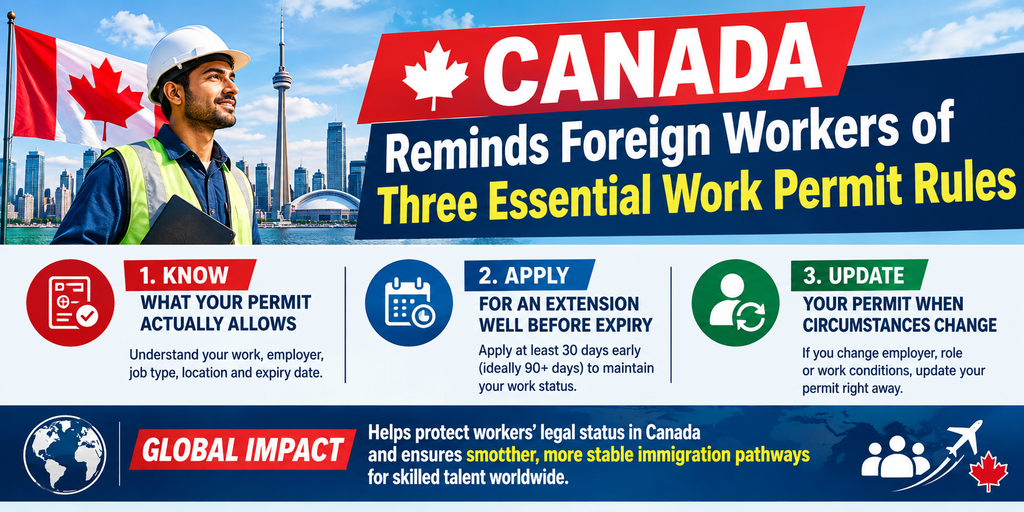
The immigration ministry of Canada has sent a new reminder to foreign employees in the nation outlining three requirements they must fulfill to maintain their legal standing. The Immigration, Refugees and Citizenship Canada (IRCC) advisory comes at a time when the nation is tightening its temporary worker intake targets for 2026, therefore increasing the expense of compliance errors for those currently living and working in Canada.
The message is straightforward but crucial: having a work permit is not a one-time success. It has constant responsibilities that staff members have to actively handle during their employment.
- Find out what your license really lets you do.
IRCC emphasizes first responsibility as one that catches many new arrivals: actually reading and grasping the small print on their work authorization. Every permission has certain restrictions linked to it, including the type of employment a person may have, the province or territory they are permitted to work in, the employer they are not permitted to labor for, and the length of the clearance.
It’s a common misconception among workers who think their license gives them universal approval to accept any work wherever in Canada. For instance, closed work permits connect a person to one job and one company. Going beyond those bounds, even temporarily or in a well-intended attempt to generate additional income, might jeopardize one’s legal status. The counsel of IRCC here is unambiguous: read the permission attentively, and if you’re not sure, check the requirements straight through official government sources rather than depending on hypotheses or unofficial guidance.
- Get an extension request in plenty of time before it runs out.
The second need concerns timing and is possibly the most important of the three. For a long time, IRCC has demanded that employees submit a renewal application at least 30 calendar days prior to the expiration of their current permission. Applying inside that window, or ideally much before it, enables a worker to take advantage of what is referred to as maintained status (previously known as implied status). This legal safeguard enables someone to keep working under their current conditions during IRCC’s evaluation of the extension request, even if the physical permit’s expiration date has already gone by.
But many employees neglect one catch: kept status only counts should the individual remain in Canada and keep working under the same conditions pending a ruling. If you switch to a type of application like a visitor record or a study permit during that waiting period your work permission stops immediately.
It’s also worth remembering that the 30-day minimum is a floor, not a goal. Due to much longer processing periods for in-Canada work permit renewals than in prior years, immigration experts more often suggest employees file their applications 90 days or more in advance of expiration. Waiting until the very last feasible moment leaves little opportunity to fix mistakes, answer requests for more paperwork, or bounce back from unanticipated delays, any of which might cause a lapse in legal validity.
- Change Your Permit If Things Change
IRCC’s reminder’s third pillar addresses life events inconsistent with what is stated on a person’s current license. A worker is needed to apply to have their conditions officially changed if they change employers, accept a different position, or go through any upheaval in their work environment not represented in their current conditions.
This is more than simply a paperwork procedure; it safeguards the employee. If a license does not correspond to a person’s actual working circumstances, it can cause major problems, from difficulties in proving legal status to potential breaches of immigration regulations, even if the modification was made in good faith.
Why This Reminder Still Counts Today
Though IRCC didn’t outline particular penalties for non-compliance, Canadian immigration law is clear that usually someone must stop working once their work permit expires without an extension application filed. Legal work status is so closely related to general immigration standing that a lapse might jeopardize a person’s capacity to stay in the nation entirely rather than only their employment.
Remember that temporary foreign workers in Canada are covered by federal, provincial, and territorial employment rules and are therefore qualified for the same basic job protections as Canadian citizens and permanent residents. Labour departments at the province level are still around to address inquiries on hours, pay, and working circumstances.
For everyone with a current Canadian work permit, the lesson is obvious: do not view your permit as a “set it and forget it” document. Mark your expiry date early. Keep an eye on your situation and take action. In an immigration process where to be delay becomes the rule instead of the exception a little proactive planning could be the difference between a seamless continuation of your work, in Canada and an unwanted interruption.