
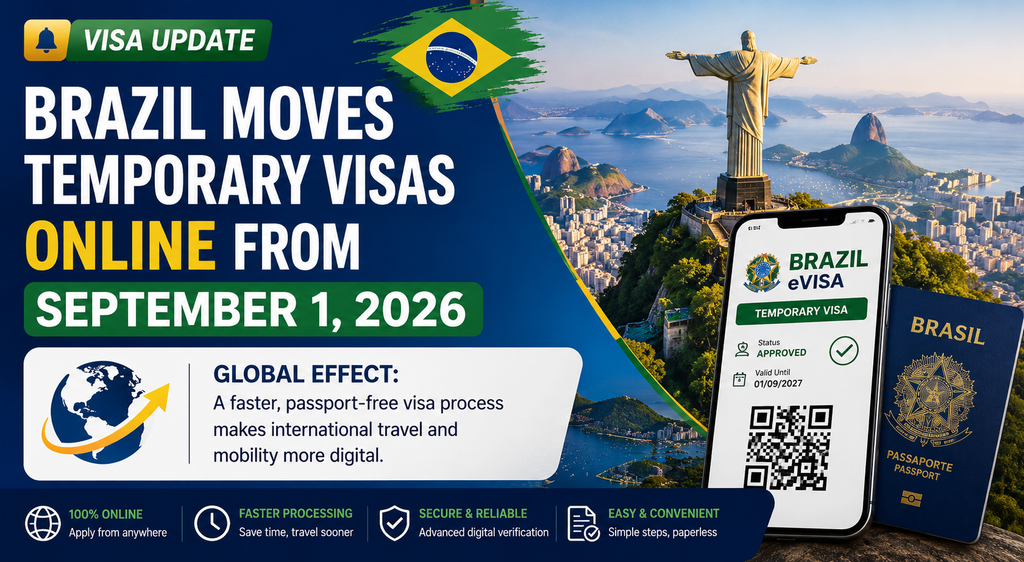
Brazil’s temporary visas go digital for visitor-visa-exempt nationals starting Sept 2026. Who qualifies, what changes, and why some consulates still use paper.
In correspondence to, VITEM visa electronic process Brazil. Brazil has moved one step closer to a fully digital immigration system. Temporary visas (known as VITEM visas) will be delivered electronically starting September 1, 2026, to citizens of countries that do not require a tourist visa to enter Brazil. In essence, this implies that many candidates will complete the consular section of the procedure without ever turning in their passport simply to have a visa sticker affixed into it.
A notice sent on August 28, 2026, by the Brazilian Embassy in Lima verified the change, but it is not only a Peruvian project. It aims to cover the entire consular network of Brazil, wherever qualified applicants are sending VITEM requests.
Who This Really Impacts
Here, accuracy is crucial since this adjustment does not impact every tourist going to Brazil.
For Business travelers or tourists from a nation already eligible for Brazil’s VIVIS, nothing varies. Short excursions are still subject to the same regulations as before.
The new electronic procedure is meant especially for visitors from VIVIS-exempt nations who require a different sort of visa, a temporary one, for uses such as:
- Learning
- Working
- Joining family now living in Brazil
- Putting money into a Business in Brazil
- Some artistic or professional pursuits
- Residing in Brazil for a while as a digital nomad
Based on Brazil’s foreign visa regulations table, this VIVIS waiver covers nationals of the United Kingdom, France, Germany, Spain, Italy, Portugal, the Netherlands, Belgium, Switzerland, Japan, South Korea, and a number of Latin American nations. For an individual from one of these nations needing a work or study visa, that paper should now be given electronically.
One significant exception: visitors from the United States, Canada, and Australia. These countries lost their VIVIS exemption in April 2025 and currently require an e-Visa only for travel to Brazil. This specific change does not affect them in the same manner as they are no longer in the exempt group.
How the Electronic System Operates
The Integrated Consular System (SCI) is the platform that the Ministry of Foreign Affairs already uses to manage visa applications. Under the rules applicants upload their forms and the required supporting documents through the SCI. After the documents are approved the visa is. Sent electronically. Usually the visa appears as a PDF, with a QR code that is emailed to the applicant of being stamped in the passport.
For Brazil, this is not altogether unfamiliar terrain. Some VITEM categories added in 2025 already used a similar electronic format, so the September 2026 change mainly extends an established process that has already undergone testing.
Legally, this has been achievable for years. Article 26 of Decree No. 9,199 (2017) already permitted visas to be requested, handled, and issued electronically free of a physical sticker. What’s altering now is the scope of usage of this choice.
Significantly, going digital does not exclude candidates from ever being requested to turn up in person. Should a case need closer scrutiny, consular officials still have the discretion to ask for original papers, request further evidence, or summon somebody in for an interview. Those requests should just be the exception instead of being a regular component of every application.
What Has Not Changed
Although the material of every visa category remains exactly as it was, it is easy to believe that a digital procedure means a simpler one. Depending on the particular VITEM category being sought, document checklists, translation and apostille criteria, and consular costs all still apply.
Particularly, work-related visas might still require prior residence authorization via Brazil’s Federal Police Migrant Web system before a consulate may proceed with issuance. For those visa classifications that demand it, registering with the Federal Police is still required even after one really reaches Brazil.

The deployment seems slower than what was announced.
Here is, when practice starts to be a little chaotic. Though September 1, 2026 marked the official start date, a review of instructions issued by Brazilian consulates in New York, Montreal, Paris, London, Barcelona, Geneva, and Porto reveals that most are still out lining the earlier, paper-based method, passport submission, in-person appointments, and physical document retrieval included as of early September.
This difference does not automatically suggest the change has stopped. Consular websites often trail policy developments just because it takes time to update hundreds of pages across a world wide network. It does imply, however, that candidates should not believe the new electronic system is currently totally operational everywhere.
Candidates Should Do Right Now: What Applicants Need to Do
The best line of action if you’re applying for a Brazilian temporary visa in the next weeks is to contact the particular consulate managing your application straight away before submitting any paperwork or your passport. Considering how recently this change went into force, procedures could differ between consulate posts until the rollout matches the policy.
For qualified travelers, however, the direction is straight forward: Brazil is going toward a system where by obtaining a temporary visa no longer entails giving over your passport for weeks at a time, even if that future has not completely arrived at every embassy just yet.
For more Information contact your country regional embassy !