
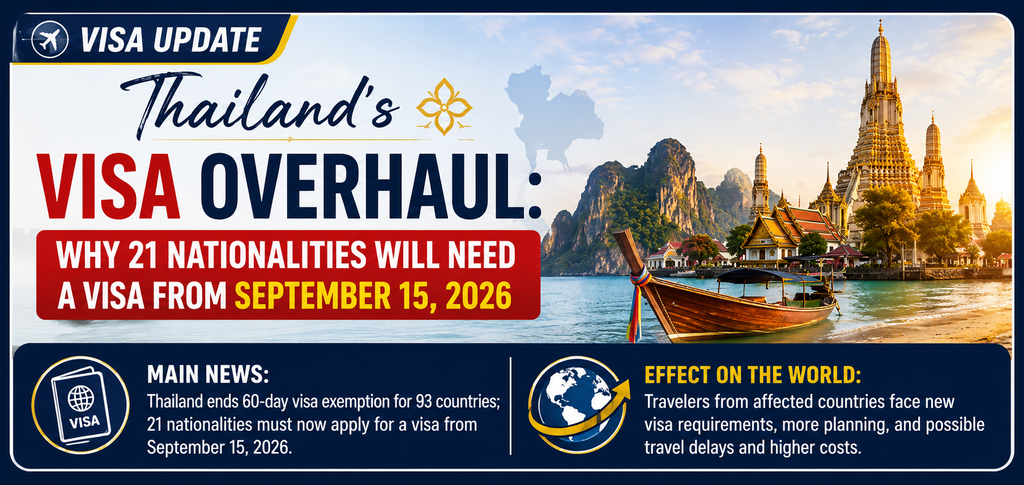
Thailand has ended its 60-day visa exemption for 93 countries, replacing it with a 30-day system on September 15, 2026, but 21 nationalities, including Mexico, Colombia, and Morocco, have lost visa-free access entirely and must now apply for a visa in advance.
One of its most liberal travel rules in recent memory is being shut down in Thailand, which is, Thailand visa-free countries 2026. The Kingdom will officially end the 60-day visa exemption that began in July 2024 for 93 nations and territories on September 15 2026. This change will replace the policy with a more focused, shorter and selective system. About twenty-one countries that now let travelers enter without a visa will soon stop giving that benefit. Those travelers will need to apply for a visa before planning any flight.
What Is Actually Changing?
The Thai Ministry of Interior issued the new laws in the Royal Gazette on August 31, 2026, enabling the public only two weeks’ notice prior to implementation. Effective September 15, the adjustments reorganize Thailand’s short-stay admission system into three primary categories.
First 60 countries and territories such as the United States, United Kingdom, Canada, Australia, Japan, India, Singapore and all 27 European Union member states will keep visa‑free entry. However the longest stay will drop from 60 days to 30 days. Anyone entering Thailand on or before September 14 will still receive the 60‑day stamp; the new rule only starts for arrivals, on September 15 and later.
Second, travelers from Mauritius and Seychelles enter a distinct 15-day visa-exemption group.
Third, Visa on Arrival, a service that formerly catered to 19 to 31 countries based on the source, is being reduced significantly to include just three nations: Azerbaijan, Belarus, and Serbia.
The 21 Nationalities
Not every nation losing its place on the 60-day exemption list is left without alternatives. Thailand runs on a one country, one privilege basis; hence, countries with already established bilateral agreements just revert to those. Argentina, Brazil, Chile, Peru, and South Korea have a 90-day exemption under this agreement; China, Hong Kong, Kazakhstan, Laos, Macau, Mongolia, Russia, Timor-Leste, and Vietnam have a 30-day allowance. Myanmar and Cambodia are still operating under a 14-day agreement.
But a different cluster of roughly 21 nations lack a bilateral safety net to rely on. Reports pointing to the new regulations list nations including Mexico, Colombia, Sri Lanka, Uzbekistan, Uruguay, Panama, Morocco, Andorra, Monaco, and San Marino as being among those now obliged to get a visa in advance, most likely via Thailand’s e-Visa gateway, instead of just arriving and getting a stamp. For nationals of these nations, instantaneous, visa-free travel to Thailand is essentially finished for the better future.
Why Thailand Is Making the Rules Stricter
Thai authorities have framed the adjustment as a shift, toward quality tourism not increasing numbers. The first 60-day exemption, introduced in 2024 was designed to boost tourist arrivals after the pandemic and encourage stays. Two years on, authorities seem to be re-calibrating, narrowing eligibility while also stripping short-term work and business activities from the scope of the exemption – the new regulations apply exclusively to tourism.
What Should Travelers Do Now?
The first step you need to do if you want to go to Thailand after September 15 2026 is to look at the situation for your nationality. Don’t think that the rules from year are still true.
- Find out which group you are in, are you on the 30-day group the 15-day group the Visa on Arrival group a country, with a special agreement or one of the countries that now need a full visa.
- Apply early if required: Start the e-Visa procedure well before your trip dates if your nation has been eliminated from all exemption categories, since processing times might differ.
- Fill out the TDAC: The Thailand Digital Arrival Card is still required for all visitors, regardless of their visa status. It must be submitted within 72 hours of arrival.
- Be aware of the land-border restriction: Visa-free arrivals across land borders are restricted to two every calendar year, with exceptions for visitors from Malaysia, Brunei, Indonesia, and Singapore.
- Learn your extension alternatives: Those with the new 30-day exemption can pay 1,900 baht to extend their stay by another 30 days at any Thai immigration office.
The Crucial Point
Thailand is still one of the destinations in Southeast Asia, for many foreign travelers. Now Thailand is getting toward the end of an era where nearly all visitors could enter without a visa and stay for 60 days. The change is manageable for the 60 nations still exempt: a shorter stay rather than a missed chance. The modification demands actual advance preparation for the maybe 21 countries now subject to a visa restriction for the first time in two years. Whatever your circumstances, the best course of action before reserving a trip to Thailand after September 15, 2026, is a quick review of the official criteria rather than depending on obsolete data.
For More Information contact your country regional embassy !