
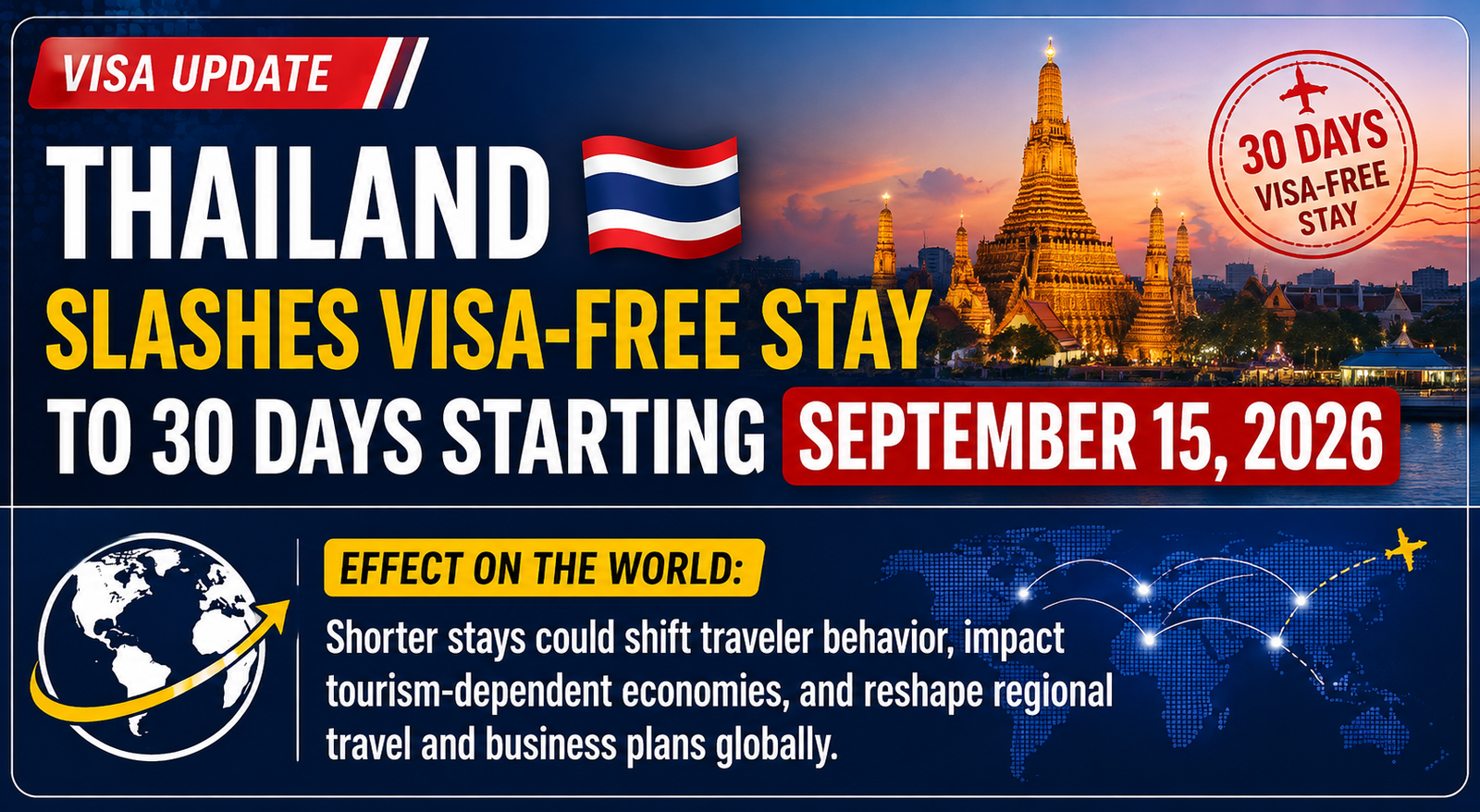
Thailand 60-day visa ending. After months of conjecture and draft ideas, the government has at last released the final legal framework in the Royal Gazette, verifying that the shorter 30-day stay period becomes official policy on September 15, 2026.
In correspondence to announcement in the August 31 2026 edition of the Royal Gazette Volume 143 Special Issue 207 Ngor. The announcement contains four Ministry of Interior regulations that explain exactly how Thailand’s entry restrictions will change. Each of the four regulations contains a built‑in fifteen‑day grace period before the rule takes effect. Because of the grace period the final cutoff date, for the entry restrictions is September 15.
Why the 60-Day Program Is Vanishing
Back in July 2024 Thailand introduced a 60‑day visa waiver program that covered 93 countries and territories. This move, by Thailand was meant to help boost tourism after years. It also made it easier for business travelers to visit for periods without needing a visa. The policy aimed to simplify travel and bring visitors into the country. The first of the recently released rules officially abolished that scheme.
Anyone who enters Thailand before September 15 under the existing 60-day allowance won’t be penalized retroactively; their originally granted stay length remains intact even after the new regulations take effect. When the reform was first passed earlier this year, Thai officials verified this temporary protection.
The New 30-Day List: Sixty Nations and Territories
The reform’s centerpiece is a new 60 countries list, that can enter as tourists for 30 days without a visa. This finally clarifies some ambiguity from prior government pronouncements, which had mentioned just 59 nations; the Royal Gazette version validates 60.
Under this category are visitors from the United States, United Kingdom, Canada, Australia, and the majority of the European Union, as well as from nations like Japan, South Korea’s neighbors in Southeast Asia including Malaysia and Singapore, and Gulf states such as the United Arab Emirates, Qatar, and Saudi Arabia. In real terms, most tourists who now have 60 visa-free days will notice that time reduced in half.
Significantly, the fresh phrasing limits this exemption only to tourism. In contrast to the previous program, it no longer expressly includes short-term commercial activity, which may be relevant for visitors who formerly depended on that flexibility.
Land Border Crossings Face New Restrictions
A restriction with actual repercussions for border-hoppers and backpackers: tourists utilizing the 30-day exemption will often be limited to two land border entrances into Thailand each calendar year. This limitation won’t apply to nationals of Brunei, Indonesia, Malaysia, or Singapore, and Thailand’s Interior Minister has the authority to award exemptions to other nationalities in the future. This specific restriction has no impact on air arrivals.
It Is Still Possible To Get A 30-Day Extension
Shorter initial stays need not spell the end of longer vacations to Thailand. Eligible visitors may request a one-time extension of up to 30 additional days via Thai immigration under the Cabinet-approved structure, hence enabling a full two-month stay for those ready to complete the documentation.
Smaller Categories: 15-Day Exemption and Visa on Arrival
Nationals of Mauritius and Seychelles receive their own distinct lane, a 15-day visa exemption, subject to the same land-border entry restrictions mentioned above. The Maldives was originally scheduled for this group but in July it was moved into the more appealing 30-day list.
Meanwhile, Visa on Arrival is declining sharply. Only three nations will remain eligible going forward where 31 now qualify: Azerbaijan, Belarus, and Serbia. Once thought to remain on the VoA list, India was moved into the 30-day exemption group instead.
Bilateral Agreements Remain untouched
This revamp has no impact on nations with stand-alone bilateral visa agreements with Thailand. That encompasses 14-day agreements for Cambodia and Myanmar, 30-day agreements with China, Vietnam, Russia, and several other nations, and 90-day exemptions for countries such as Brazil, Argentina, and South Korea. In keeping with Thailand’s larger one nation, one system attitude, these sit completely outside the revoked scheme.
Some Nationals Will Now Need a Visa
Travelers from nations formerly covered by the 60-day exemption but missing from all three new lists will have to obtain a visa prior to entering Thailand, unless a different agreement pertains to them. Thailand’s online e-Visa system, which has been in use since January 2025, makes it easy for these candidates to apply.
Bottom Line
From September 15, 2026, Thailand’s entrance scene will run on three main lines: a 30-day exemption for 60 countries, a 15-day exemption for Mauritius and Seychelles, and Visa on Arrival restricted to Azerbaijan, Belarus, and Serbia—all layered with current bilateral agreements. Everyone entering before the deadline maintains their current stay length; however, those organizing travels after mid-September should consider the reduced window and the extension process into their schedules.