
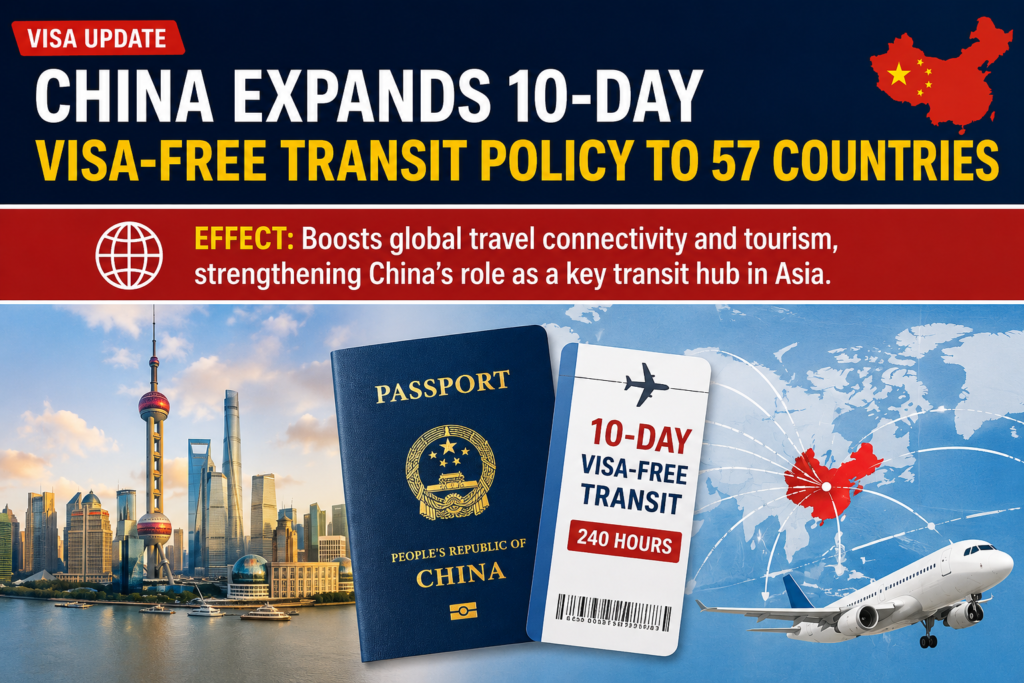
China has quietly grown to be among the simplest nations in Asia to transit without a visa, provided you are genuinely transiting. If tourists from 57 nations are headed for a third nation or territory, they may now spend up to ten full days inside China, without submitting a visa application in advance, thanks to the addition of Kyrgyzstan and Vietnam to the initiative on August 20, 2026. Tourist visas are typically exempted from this, unlike other exemptions.
What Specifically Is This Policy?
Under the rule, formally known as the 240-hour visa-free transit policy, qualified citizens can enter China without a visa and stay for up to 10 days, but only in certain areas and only if China serves as a stopover between two other countries.
The reasoning is simple: if you fly from New York to Shanghai then on to Tokyo, you probably qualify, fly from New York to Shanghai and from there to New York back. There is no third destination involved. Since Hong Kong and Macao also qualify as legitimate onward destinations, paths such as Shanghai to Hong Kong can also meet the criteria. In the end, the immigration officer at the border determines whether your itinerary qualifies, hence arranging your papers counts.
Who May Utilize It?
57 countries are represented as of the August 2026 expansion. That encompasses 40 European nations, from France and Germany to the United Kingdom, Poland, and Russia, as well as Brazil, Canada, the United States, Mexico, Argentina, and Chile in the Americas, Australia and New Zealand in Oceania, and nine Asian nations including Japan, South Korea, Singapore, the United Arab Emirates, and the recently added Kyrgyzstan and Vietnam.
Specifically, many large countries, including Americans and Mexicans, rely heavily on this transit program since they do not qualify for China’s distinct 30-day general visa exemption, as detailed further below.
What You Really Require
Merely being eligible won’t get you past immigration. travelers also need:
- A passport legitimate for at least three months
- Evidence of meeting entry criteria for their next location, including a visa there, should it be needed
- A confirmed ticket leaving the 240-hour window
- Entry via one of the 65 designated ports
- A promise to remain inside the accepted travel areas.
There isn’t a different transit visa to apply for ahead of time. Border officials instead handle your temporary admission on arrival, and several visitors now submit their information in advance via China’s online e-Arrival Card system to hasten the process.

How the Clock Really Runs
Here’s one thing that gets people confused, that, The 240 hours don’t start counting the moment you get here. China’s National Immigration Administration states that the official countdown starts at midnight following your day of arrival. Land in Shanghai on the afternoon of September 1st, and your 10-day window technically starts at 12:00 a.m. on September 2nd, effectively giving you a bit more time than a strict 240-hour count from touchdown would suggest.
Where Can You Travel?
It has access to the sea and coast through 65 ports, including airports, seaport sites, railways stations, and land crossing points for 24 province(enumeration of languages) and cities. Five new bridges, including the Hong Kong-Zhuhai-Macao Bridge and the West Kowloon rail terminus, were added to Guangdong’s total as early as November 2025.. Some areas, like Shanxi, Guangxi, and Yunnan, limit visitors to certain cities within them.
The fact that you may move across numerous qualified provinces on a single visa-free admission and are not obliged to leave through the same port you entered from, as long as your entire path stays within authorized areas and the 10-day limit, is among the more travel-friendly aspects of the present regulations.
Not Just a Layover Anymore
This window is not limited to airport lounges, but can also be used for tourism, business meetings, or visiting family and friends. The requirement for activities such as paid work, formal schooling, or journalism is not replaced by a visa.
Transit Exemption vs. the 30-Day Visa Waiver
You may not need the transit path at all if you are French, British, Canadian, Belgian, Swiss, or from one of around 50 other qualified nations. China independently gives these countries a 30-day visa exemption for travel, business, or family visits; no onward travel is needed. Most of these exemptions expire at the end of 2026; Russia’s is extended to 2027 and Brunei’s is presently endless.
The difference is clear, that the 30-day waiver is for a single trip to China, the 240-hour rule is just for passengers passing through China en route to somewhere else. The 10-day transit rule is still the most convenient way to see China for countries like the US and Mexico, who are not on the 30-day exempt list, without having to fill out a full visa application.
For further information, contact your country regional embassy