
The US just made its visa bond rule permanent. Here’s who pays the price.
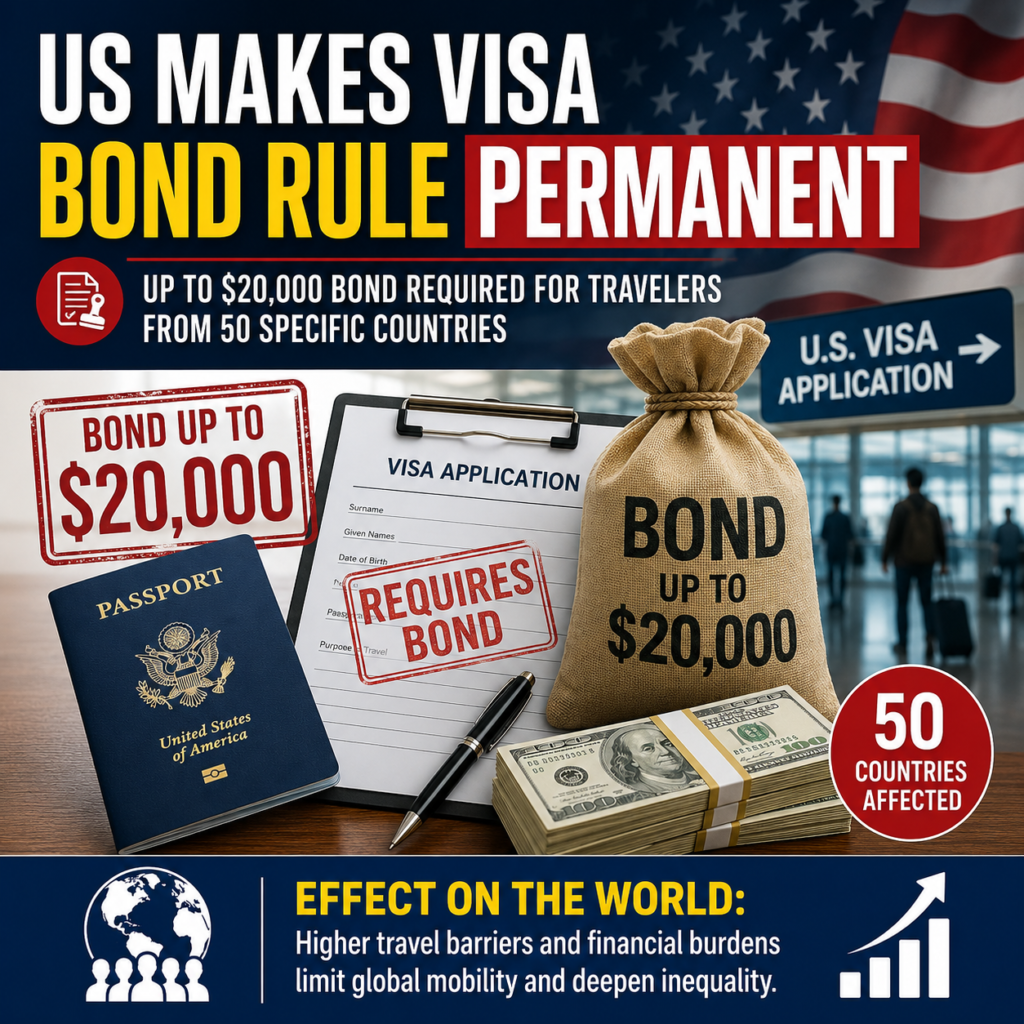
Should you be organizing a trip to the United States and happen to possess a passport from one of 50 particular nations, you might soon require much more than a flight ticket and a hotel reservation to gain entrance. You might require up to $20,000 sitting in a bond only for the privilege of applying.
A notice published in the Federal Register on Friday verified that the US State Department is converting what was formerly a temporary experiment into a permanent feature of American visa policy; this is the new reality. The regulation focuses on B1 and B2 visas, the most common types for short-term travel and tourism, and gives consular officials broad authority to ask for a financial bond before granting approval.
From Trial Project to Regular Programme
This did not arise out of nothing. Back in 2025, the State Department, in collaboration with the Treasury Department and the Department of Homeland Security, introduced a trial version of this bond program. On paper, the concept was straightforward: find out if requiring tourists to pay refundable bonds really reduces visa overstays. It is now believed by officials that the information obtained during the trial period was convincing enough to warrant implementing it as an ongoing rule rather than just one-time trial.
$5,000, $10,000, and $15,000.00 was the maximum bond amount that consular officers could offer in the first pilot. The approved guideline eliminates the lowest tier totally and increases the cap to $20,000. To put it another way, the standard has increased rather than simply remaining unchanged. The law is planned to go be implemented on August 3, the same day that it is formally published in the Federal Register.
Who is influenced?
The list of 50 nations whose residents come under this policy was originally made public back in May, and the geographical trend is rather clear. There are thirty countries from the list that’re in Africa. These African countries are included, which are Nigeria, Ethiopia, Senegal, Tanzania, Uganda and Zimbabwe. The other twenty countries are in parts of the world. We have countries like Cuba, Venezuela, Nicaragua, Bangladesh, Nepal and Mongolia. These countries are in the Caribbean Central Asia, the Pacific Islands and Latin America. We see countries like Nigeria and Zimbabwe in Africa and countries like Cuba and Venezuela, in the Caribbean and Latin America.
Travelers from these nations may now find a regular visa application combined with a five-figure financial obligation determined on a case-by-case basis at the discretion of the submitting officer reviewing the file.
Two Hugely Different Perspectives
Not unexpectedly, the policy divides opinion exactly in half. US officials present it simply as an enforcement tool, a means of discouraging individuals from overstaying their visas once they are in the nation, as the bond is supposedly forfeited should the passenger fail to depart on time.
Immigration supporters view it very differently. Their worry is that a $20,000 bond is not a small deterrent for those who break the rules; rather, it is a clear impediment for regular, law-abiding travelers who just do not have access to such funds. A company proprietor wishing to attend a conference or a family wishing to visit relatives may be completely priced out, irrespective of how genuine their travel actually is.
Human rights organizations have gone even further, connecting this law into the broader pattern of the immigration policy of the Trump administration. Critics contend that the increased crackdown begs grave concerns regarding due process and free expression and runs the danger of creating an environment whereby ethnic minorities especially are more likely to experience racial profiling. For its part, the administration argues that these actions are motivated by national security issues rather than any desire to aim at particular groups.
The Broader Immigration Context
The difference it highlights with the government’s own stated objectives makes this development noteworthy. Officials have consistently stated their emphasis is on reducing illegal immigration; yet, several recent legislative developments have also made legal immigration noticeably more challenging to negotiate. Some visa types have seen a significant increase in application costs. Social media verification has evolved into a regular component of the screening process used for both new applicants and individuals now residing in the United States on current visas.
Taken together, the visa bond rule fits into a pattern rather than standing alone. For residents of the 50 specified nations, it can be the layer that determines whether a US visit is even financially viable; it is one more layer added to an already complicated system.
What Happens Next
Travelers from the impacted nations will want to consider this into their preparation well in advance of any trip given the formal implementation of the rule on August 3. A concern that will probably take months, if not years, of real-world data to address is whether the policy really lowers overstays or just lowers the number of individuals who can afford to travel legally in the first place.
One thing is evident right now: submitting a US visa application became much more expensive for a rather specialized segment of tourists worldwide.