
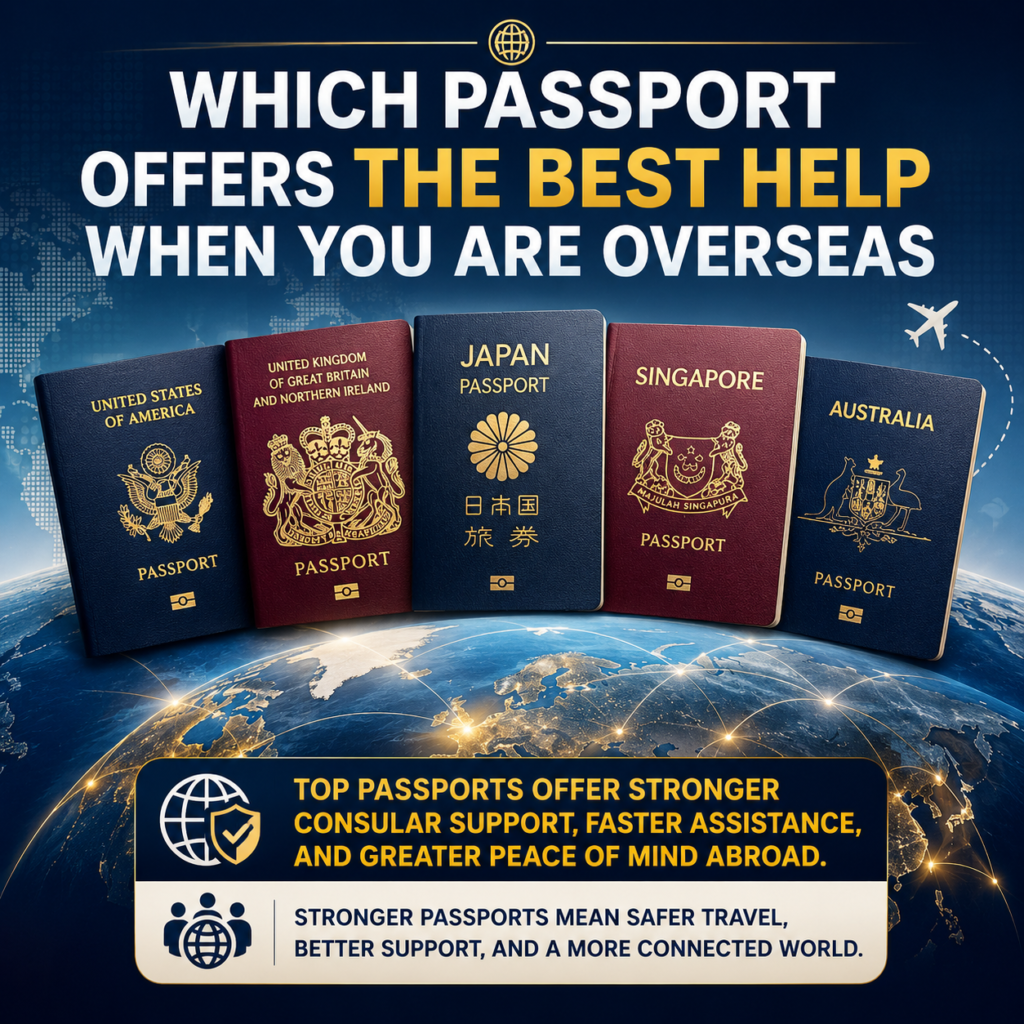
When we think about how good a passport’s we usually consider how many countries it lets us visit without a visa. There is something more important to think about especially when things get tough. That is the help you can get when you are in trouble in a country. One type of nationality is really good at helping its people when they are in trouble. This is often overlooked.
A list of passports will show you how countries you can visit without a visa. It does not tell you who will help you if your wallet is stolen in a foreign city if you are arrested by the police if you need medical help after an accident or if you are trying to leave a country that is having big problems. That is where the help from your government comes in, this is called assistance. Most governments do not think this help is necessary. The British government says clearly that you are not entitled to this help and you should not expect it, Australia and Canada says so.
The European Union is different. It says that its citizens have the right to be protected and this is written in its laws. If you have a passport from a European Union country you have the protection available.
The lists that rank passports do not consider these things. They only look at how countries you can visit without a visa and they do not think about how much help you can get when you need it.
Here is some general and signified information about what this protection means and how different passports compare.
What Does Consular Protection Mean?
The help that your government gives you when you are in trouble in a country is mostly defined by a big agreement called the Vienna Convention on Consular Relations. All countries follow this agreement. It says what your governments representatives should do to help you when you are in trouble. They should give you emergency travel documents help you if you are a victim of a crime help your family if you die in a foreign country and help you during big crises like natural disasters or wars.
If you are arrested in a country you have the right to contact your governments’ representatives and receive visits from them. This is very important if you are far from home. How good your passport is in these situations depends on three things: how places your country has representatives how good the help is that they give and how well your government can get you out of a country that is having big problems. No passport is the best in all three areas.
How Many Places Your Country Has Representatives Is One Thing to Consider
The best way to measure how many representatives a country has is to look at the Lowy Institutes Global Diplomacy Index. The diplomatic missions of different countries worldwide are documented in this index. In 2024, The United States led in the number of missions with 271 and 274, respectively, after China. Both countries. Having many representatives is just the first step. The quality of the help they give and how ready they are to give it are also important. The Lowy index only looks at 66 countries and territories. It only counts the number of missions not the quality of the help.
Why One European Union Passport Is Better Than Others
The European Union has a system that makes its passports better. The laws of the European Union say that each member country must help citizens of member countries in the same way that it helps its own citizens.
This means that if you have a passport from one European Union country you can get help from any European Union country if you need it. This is a strong safety net. If you have a passport from Portugal or Ireland you can get help from all 27 member countries of the European Union.
This is not a theoretical idea. During the COVID-19 European Union countries worked together to bring home over 600,000 citizens who were stuck in foreign countries. The European Union also created a travel document that citizens can use if they lose their passport in a country where their own country does not have a mission.
There are some limits to this system
Each country must treat citizens of member countries in the same way that it treats its own citizens but there is no minimum standard of help that they must give. This means that the quality of the help can vary depending on which country you contact.
This right to help is for citizens of the European Union. If you are a citizen you do not have this right anymore because the United Kingdom left the European Union. While a British passport still gives you some help it is not as good as a European Union passport.
How Well Your Country Can Get You Out of a Country in Trouble Is Also Important
Getting citizens out of a country that is having problems is a different challenge than having many representatives. Some countries are better than others, in this context. For example during the conflict in Sudan in 2023 some countries were able to evacuate their citizens and others were not.
India is an example of a country that is good at evacuating its citizens. Even though India does not have many diplomatic missions as some other countries it has a history of successfully evacuating its citizens from countries in trouble.
For citizens of the European Union evacuation is first handled by their country and then by the collective system of the European Union. This system works well when a big member country takes the lead. It can be limited for citizens of smaller member countries that do not have the ability to evacuate their citizens on their own.
When Your Passport Does Not Protect You
There is one rule that people with two passports should know about. Usually a country will not help you if you are in the country of your nationality. This is because that country considers you to be one of its citizens.
For example if you are a Iranian dual citizen and you are in trouble in Iran the United Kingdom may not be able to help you. This is what happened to Nazanin Zaghari-Ratcliffe, who was held in Iran for years.
If you have two passports the second passport can give you options for travel and living but it does not give you more protection in the country of your other nationality.
The Caribbean Passport and the Commonwealth
For people who are considering getting a passport through investment the Caribbean passport is a popular option. The five countries that offer citizenship by investment, includes, Antigua and Barbuda, Dominica, Grenada, Saint Kitts and Nevis and Saint Lucia, and all are part of the Commonwealth.
This means that if you have a passport from one of these countries you can get help from the United Kingdom in countries where your own country does not have a mission. This is a safety net but it is not the same as having a passport from a country, with a strong diplomatic presence.
Why a Golden Visa Does Not Give You European Union Rights
If you are considering getting a residency or citizenship it is important to know that only citizenship gives you the rights of the European Union. A residence permit, including one that you get through a visa does not give you these rights. This means that if you want to have the protection of the European Union you need to get citizenship, not a residence permit.
You can possess an EU residence card for an extended time and stay outside the treaty until you become a citizen. This difference became more pronounced after Malta discontinued its last direct citizenship purchase option. On April 29, 2025, the European Court of Justice determined that Malta’s citizenship initiative violated EU regulations, leading Malta to abolish it that July through the enactment of Act XXI of 2025. Currently, no EU member country sells citizenship directly, meaning that obtaining an EU passport and the associated consular rights relies on naturalization after fulfilling a residency requirement or through ancestry.
For the millions eligible by family heritage, acquiring citizenship through descent (jus sanguinis) in nations like Ireland is frequently the quickest route, This principle also applies in other contexts: Certain classes of British citizenship, such as British National (Overseas), allow access to UK consular assistance even without residency rights, as consular support is linked to the nationality held, not the place of residence.
Collaborative agreement between countries
Smaller collaborative agreements also exist among countries. The Nordic nations support each other’s citizens, while Canada and Australia have historically shared consular resources when one of them does not have a diplomatic presence. However, none of these systems compares to the extent or legal backing provided by the EU right.
Implications for Your Additional Passport
In case securing consular assistance is crucial, factor in three factors instead of just one: the extent of a nation’s connections; its ability to effectively evacuate citizens from crises; and whether the passport works with other countries for security.
A passport from the United States, Turkey, or France combines an extensive network with a reliable evacuation history, even though the assistance offered is still at the discretion of those nations. An EU passport stands out as it guarantees protection as a legal right, drawing support from 26 additional governments when your home country cannot assist.
All options come with two limitations. The EU right ensures equal treatment among citizens, but not necessarily a consistent standard, and no passport, whether from the EU or elsewhere, offers protection within a country that also considers you as a citizen. For those investing in mobility, this distinction is significant. A golden visa permits residence in Europe, but true citizenship provides a claim to Europe when you are elsewhere and face difficulties.