
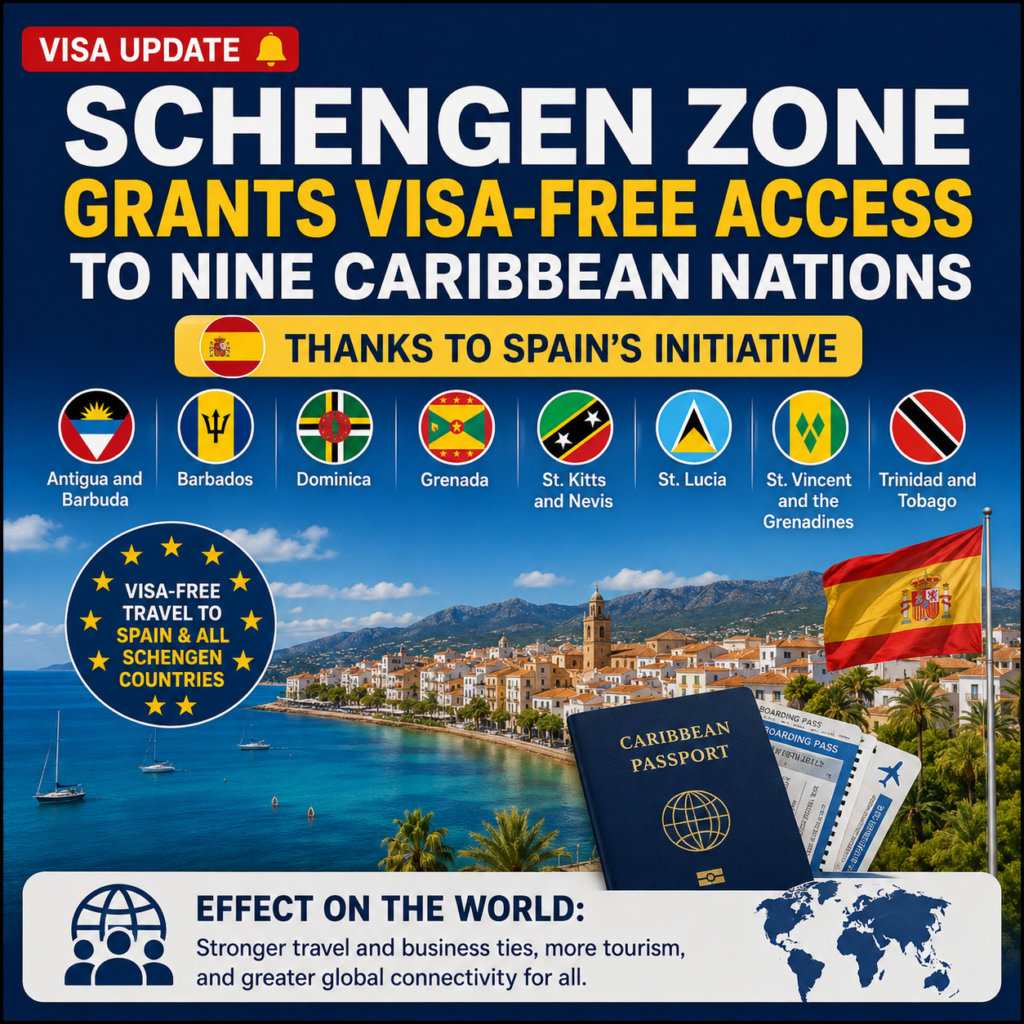
The Schengen Zone grants visa-free access to nine Caribbean nations, thanks to Spain‘s initiative.
Nine countries have made it much simpler for people from those nine countries to travel to Europe. The Spanish Foreign Affairs Ministry has said that people from Antigua and Barbuda, Barbados, Dominica (save St Lucia), Grenada, and more Along with Trinidad and Tobago, Kitts and Nevis, St. Lucia, St. Vincent and the Grenadines qualify for visa-free travel to Spain and other Schengen Area nations. The information is meant for families who wish to send children on summer vacations or run business in Europe.
The true meaning of Announcement?
A list of 60 countries where visa-free travel is available to citizens for a period was created by Spain. The list contains nine Caribbean countries. During a 180-day period, visitors, business travelers, and vacationers from these nations may stay in Spain and other Schengen nations for up to 90 days, but they cannot stay to work.
Don’t forget, this isn’t a rule. This regulation was already established in the European Union, Spain is reminding everyone about it. For those unfamiliar with it, this is a great opportunity to visit Europe and serve as reassurance.
The countries that were not included in the list
There are no Caribbean nations on the list. To travel to Spain or any other Schengen countries, individuals from Jamaica, Guyana, Suriname, Belize, and Haiti must still obtain a visa. The oil industry in Guyana is thriving, making it an unjust country for these countries. It is clear that travel between Caribbean countries remains uneventful. The ease of visiting Spain is not only for people from the Caribbean. People from eight nations are getting access. The countries like Botswana, Namibia and Eswatini, Lesotho, Mauritius, Seychelles, Cape Verde, and Rwanda, are included in this.

Important things that Tourists should keep in mind
The absence of a visa requirement for traveling to Spain means that arriving at the airport with anticipation is not feasible. Checks at the border are still necessary for them. They must also have a passport, which is under 10 years old and has been in use for at least three months after they decide to leave the Schengen Area. Furthermore, they must have a lodging location and arranged to return home with sufficient funds to cover their travel expenses.
Travelers should not assume they will be able to access these documents at the border as long as they ask for permission. A visa requires minimal paperwork for them. ETIAS is poised to undergo a significant transformation.
The information required for travelers
The European Union will initiate the creation of ETIAS. The system will necessitate that individuals without visas fill out an online form before boarding a flight to Europe. This isn’t a visa, The European Union has adopted this approach to monitor visitors.
This implies that individuals cannot simply show up at the airport with their passport and anticipate boarding an aircraft. The form is the first one they will have to complete. Despite its importance, this is only a small step.

Why This Matters for the Caribbean
The availability of visas for the nine countries on the list makes it a significant advantage to enter the Schengen Area. This is good for tourism, business and people who just want to visit Europe.
For the countries that’re not on the list this is a reminder that they need to keep working with the European Union to make it easier for their citizens to travel, as Spain welcomes millions of visitors every year it is important for people to stay informed about the rules, for visiting the Schengen Area.