
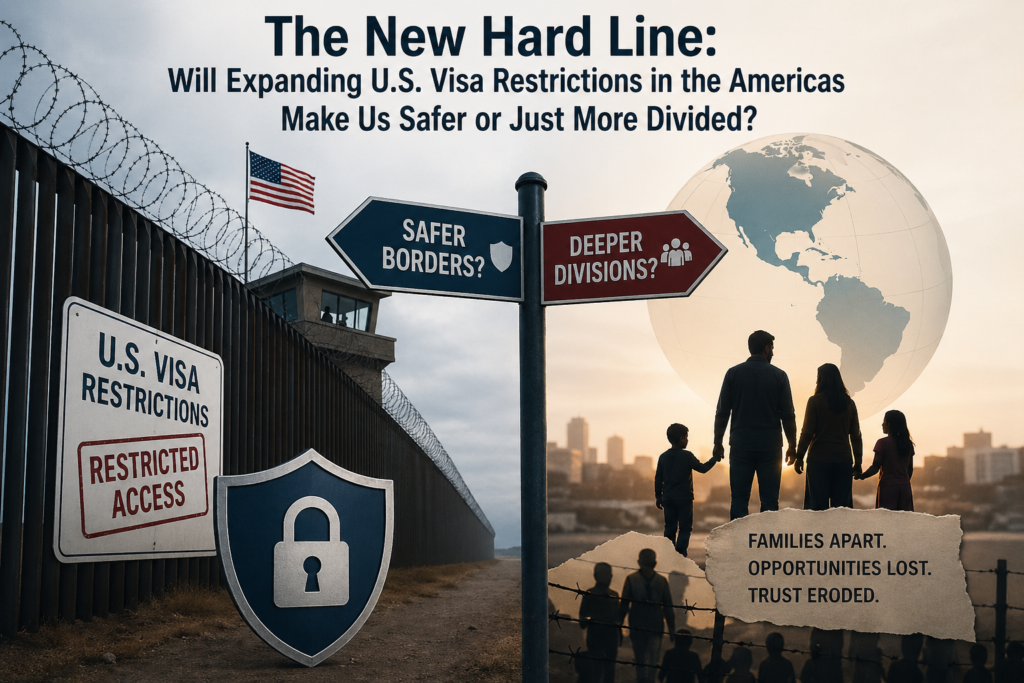
The United States is changing the way it uses visa policy. This gives the State Department power to stop people from entering the country if they’re linked to bad conduct anywhere in the Western Semicircle. This can affect a lot of people from government officers to individualities.
The idea is simple anyone who helps make the Americas unstable from Central America to South America might not be suitable to enter the United States. As the United States starts using this approach more it raises a big question will it really make the region safer or will it just make the problems worse?
What Has Changed?
In the once visa restrictions were more limited. They generally targeted officers who were loose or violated rights. Now the description of an action has been broadened. It includes crimes like trafficking and smuggling across borders using groups to destabilize neighboring countries launching cyber attacks on important structure and snooping in choices.
The policy can also affect family members, which’s analogous to what’s done in profitable warrants to increase pressure. The thing is n’t to stop people from migrating but to limit access to the United States for those who contribute to systematized insecurity.
Advantages
People who support visa restrictions see them as a way to apply pressure without causing detriment.
- Deterrence: If people involved in conduct can not travel to or engage with the United States it raises the stakes for them.
- Support for abettors : Countries like Panama and Costa Rica may have power when dealing with felonious networks that operate in their regions.
- Smaller safe havens : Indeed if the United States can not extradite someone that person can no longer use the United States as a place to go. Overall the policy helps to screen out high- threat individualities and limit their movement. pitfalls Involved Critics argue that the policy could make effects worse of better.
- Reduced communication : If the United States cuts off access it may exclude channels that are useful for accommodations or participating intelligence.
- Relegation of crime : Stopping people from entering the United States does n’t break up groups. It may just push their conditioning to other places.
- Perceived overreach : Some countries may see this as the United States trying to put its will given the history of the region. As one diplomat from the region said, visa bans may not affect the leaders of groups but they can alienate mid-level officers who might else cooperate with the United States. Neither a Complete result nor a Major trouble Visa restrictions can help policymakers apply pressure. They don’t break the underpinning problems of corruption or violence. For people affected on the ground the impact may be small. Their effectiveness depends heavily on how they are used. If used precisely they can limit the conduct of individualities. If used astronomically they risk making pressures worse and undermining cooperation.
- Visa programs alone won’t fix the root causes of insecurity. still when used in a way they can limit the reach and mobility of problematic individualities. The key is to find a balance. Without sweats to go on with the restrictions indeed well- intentioned bones
may not work. In the end their success will depend lower on how strict they are more, on how wisely the United States uses them. The United States needs to use visa restrictions in a way that helps to make the region safer not to apply pressure.